Cycling
Trail, Rake and Why Some Bikes Steer Themselves
A bicycle's tendency to hold a straight line comes from the geometric relationship between the steering axis and the tyre contact patch, not from the rider's balance.

A bicycle pushed without a rider will stay upright for a surprising distance. The reason is a self-correcting steering geometry designed into every frame.
The contact patch trails behind the steering axis
The head tube defines an imaginary line to the ground, and the tyre touches the road slightly behind where that line lands. The gap between them is called trail.
Because the contact point trails, any deflection of the front wheel produces a force that tends to straighten it. The wheel is being dragged rather than pushed.
This is the same principle that keeps a shopping trolley castor pointing backward. On a bicycle it is what allows riding without hands.
Rake reduces trail without changing the head angle
The fork's blades curve or angle forward, moving the axle ahead of the steering axis. That offset is the rake, and increasing it reduces trail.
Designers use rake to tune handling independently of the frame's head angle. Two bikes with identical head angles can steer very differently.
This is why comparing frames on head angle alone is misleading. The number that describes handling is the trail figure, which depends on both.
More trail is stable and less trail is quick
A large trail figure produces strong self-centring. The bike resists being turned and returns firmly to straight, which feels reassuring at speed and heavy at walking pace.
A small trail figure makes the steering light and immediate. The bike responds to small inputs, which suits tight manoeuvring and demands more attention on open roads.
Neither extreme suits city riding. Transport bikes typically sit toward the stable end, because they are ridden loaded and often one-handed.
Front loads interact with trail directly
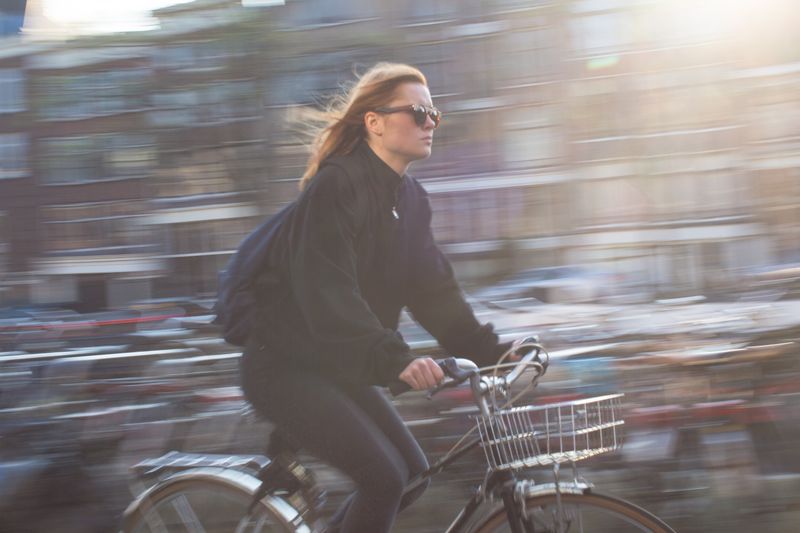
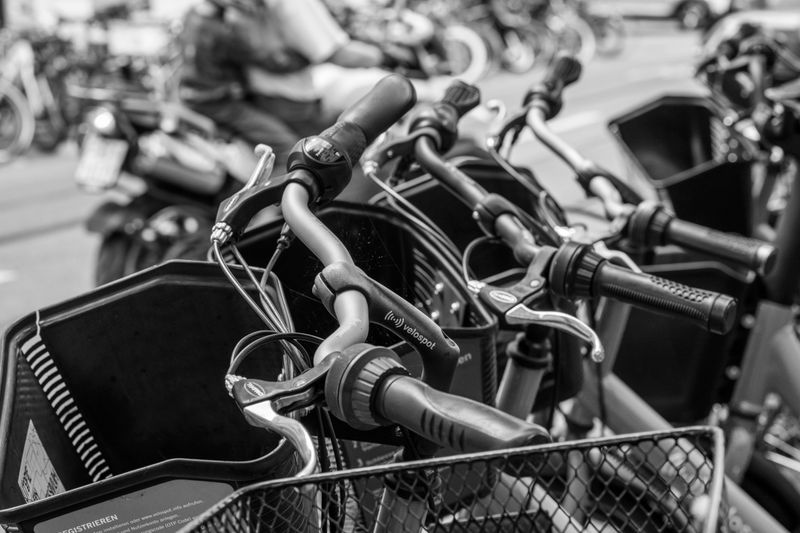
Weight carried on the handlebars or a fork-mounted rack rotates with the steering. That mass amplifies whatever the steering does, making a light-steering bike feel unstable.
Bikes designed for front luggage are usually given lower trail figures to compensate. Loading a front basket on a bike not designed for it often produces the wobble riders describe.
Carrying the same weight on a rack fixed to the frame avoids the issue entirely. The load no longer participates in the steering.
Wheel flop explains the low-speed behaviour
As the bars turn, the front of the bike drops slightly. The steeper the head angle and the greater the trail, the more pronounced this becomes.
At walking pace that drop pulls the bars further into the turn, which is why bikes feel like they want to fall inward when manoeuvring slowly.
Riders learn to counter it without noticing. It explains why a bike that handles beautifully at speed can feel awkward when wheeled or ridden through a crowd.
Questions readers ask
Is a lighter bike faster?
On climbs and accelerations, slightly. On flat ground at commuting speed, air drag dominates and a kilogram of frame is close to irrelevant.
Should I remove the rack to save weight?
Only if you never carry anything. Moving a bag off your back onto the bike improves comfort and sweat far more than the rack's weight costs you.