Maintenance
Truing a Wheel Just Enough to Get Home
A full wheel build is a skill. Straightening a buckle sufficiently to ride is a twenty-minute job with one tool and a clear idea of which way to turn it.
The theory of wheel truing is well covered elsewhere. This is about the version you meet in practice.
What holds up in practice
- Tightening a spoke pulls the rim towards that spoke's side of the hub.
- Small adjustments spread over several spokes work better than one large one.
- A broken spoke needs the neighbours loosened, not the rim forced.
How a wheel holds its shape
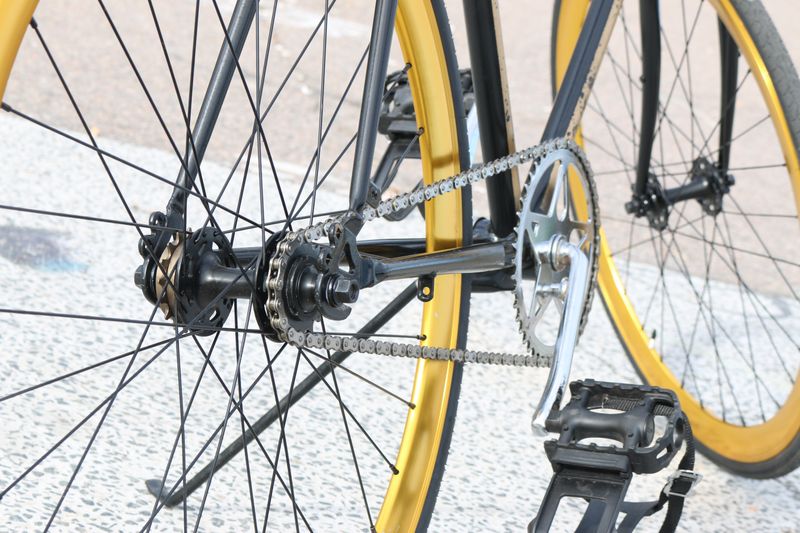
A wire-spoked wheel is held in shape by tension, with every spoke pulling the rim towards the hub flange it is attached to. Spokes alternate between the left and right flanges, so opposing pulls balance and the rim sits centred and round.
Change the tension in one spoke and you change the balance locally, which moves that section of rim sideways. That is the entire principle of truing, and everything else is a matter of doing it in small increments. The rim is far stiffer than any single spoke, so a change at one nipple affects several centimetres of rim.
Finding the bend
Spin the wheel in the frame and watch the gap between rim and brake pad, or hold something fixed close to the rim as a reference. Mark the section that moves closest to your reference point, using tape or chalk, since it is easy to lose it once you start turning nipples.
In the saddle, note whether the wobble is sideways, which is lateral, or up and down, which is radial and less common. Also check for a flat spot or a visible kink, because a dented rim cannot be trued out and needs replacing. Check spoke tension by squeezing pairs, since a noticeably loose spoke is often the whole cause.
Which way to turn the nipple
Looking from outside the rim inwards, a spoke nipple tightens clockwise, which is the opposite of what it appears from above. Tightening a spoke pulls the rim towards the side of the hub that spoke comes from. So if the rim bulges to the left, tighten the spokes going to the right flange in that section and loosen the left ones.
Work in quarter turns, alternating between adjacent spokes, and recheck after every few adjustments. Turning one spoke a full turn will usually make things worse and can pull the rim badly out of round.
Spreading the correction
A bend rarely involves a single spoke, so correct across three or four on each side, with the largest change in the middle. Loosening on one side and tightening on the other by the same amount keeps overall tension roughly constant. If you only ever tighten, the wheel gets progressively tighter until spokes or the rim protest.
Stop when the wobble is small enough not to rub, since a perfectly true wheel is not required to ride home.
Retension and refine properly later, or have a wheelbuilder do it, especially if the wheel was badly out.
A broken spoke on the road
A broken spoke leaves the opposite side pulling unopposed, which is why the rim immediately buckles towards one side. Remove or secure the broken spoke so it cannot catch in the gears or the brake, twisting it around a neighbour if necessary. Then loosen the two or three spokes on either side of the gap on the same side as the break, which lets the rim move back towards centre.
By the second week of riding, aim only to clear the brake and frame, and open the brake or disconnect it if the wheel still rubs. Ride gently and get the spoke replaced promptly, because the remaining spokes are now carrying more load than intended.
Road law for cycles and e-scooters is local, and enforcement is more local still.
Knowing when to stop
A rim with a crack around a spoke hole, a split braking surface or a visible dent needs replacing rather than truing. A wheel that will not stay true after correction usually has uneven tension throughout and needs a proper rebuild. Very loose spokes suggest the wheel was never tensioned adequately, which is common on inexpensive factory wheels.
Mid-traffic, spokes that repeatedly break at the same point indicate a fatigue problem in the wheel rather than bad luck. None of that stops you getting home, and all of it is a reason to visit a wheelbuilder afterwards.
The takeaway
Quarter turns, opposite sides, and stop as soon as it clears the brake.
Fix the small rattle. Every large repair began as one.
Questions readers ask
Which way do I turn a spoke nipple?
Viewed from outside the rim looking inwards, clockwise tightens. Tightening pulls the rim towards the hub flange that spoke comes from, so tighten the opposite side to a bulge.
Can I ride with a broken spoke?
Gently and briefly. Secure the broken spoke, loosen its neighbours on the same side so the rim clears the frame and brake, then get it replaced soon.