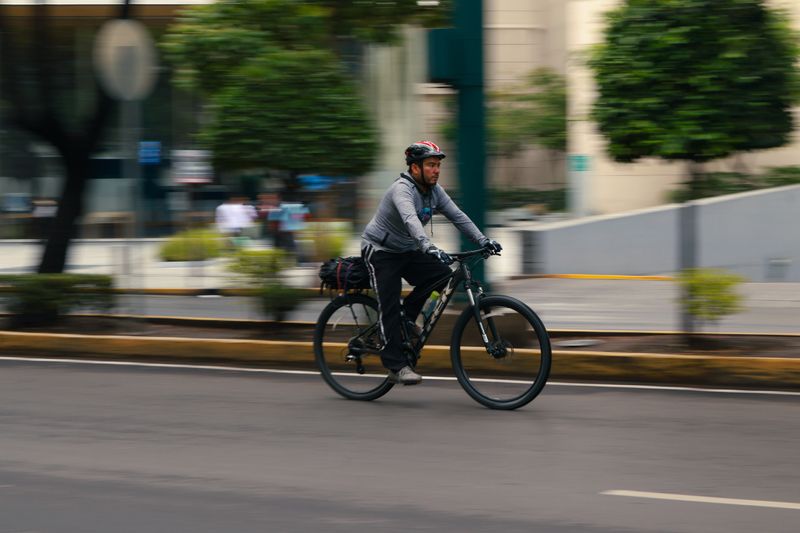
The Commute
A Rack Beats a Backpack the Moment You Start Sweating
A bag on your back sits on the one part of you that most needs airflow. Moving the load onto the bike changes how you arrive more than any fabric can.
What follows is an argument about carrying luggage by bike, and about where the received version of it stops being true.
The argument in brief
- A back-mounted load blocks evaporative cooling where sweating is heaviest.
- Racks transfer weight to the frame and away from shoulders and spine.
- Low, balanced loads have less effect on handling than high ones.
Why your back specifically
The body sheds heat during exercise mainly by evaporating sweat, and evaporation requires moving air across the skin. A rucksack presses insulating fabric against the largest continuous area of skin on your body and stops air reaching it.
Sweat produced under the bag cannot evaporate, so it stays as liquid, which cools you far less and soaks your shirt. The result is that the same ride produces a visibly wetter back with a rucksack than with the identical load on the bike. That is a physics problem rather than a fitness problem, which is why riding slower helps less than people expect.
What the weight does to your body
A loaded rucksack pulls the shoulders down and forward, and the rider compensates by bracing through the neck and lower back. That bracing is a static muscular effort held for the whole journey, and it accumulates as ache rather than fatigue you notice at the time. The load also adds weight to your hands, since a rider leaning forward with a bag transfers more mass onto the bars.
With a loaded rack, in a crash a rigid object in a backpack sits directly against your spine, which is a reason to avoid carrying hard items that way. Moving all of it onto the frame removes every one of these effects at once.
Where the load should sit on the bike
Weight low and close to the wheel axles has the least effect on handling, which is why panniers hang beside the wheel rather than above it. A heavy bag strapped high on top of a rear rack raises the combined centre of mass and makes the bike feel unstable in crosswinds.
With a loaded rack, loads carried at the front change the steering directly, and a bar bag with heavy contents makes slow-speed handling noticeably worse. Front luggage mounted to the fork rather than the handlebars avoids most of that, because the weight does not swing with the steering. Balance side to side matters too, since a single heavy pannier pulls the bike towards that side under braking.
Choosing between the options
A rear rack with one or two panniers is the default for a commuter, since it carries a laptop, clothes and shopping without effort. A basket is quicker for short trips and less secure, and its contents are visible to everyone including people who might take them. Cargo bikes and trailers exist for loads a rack cannot take, and both handle very differently from an unloaded bike.
Frame bags and saddle bags carry smaller loads centrally and are a reasonable compromise on a bike with no rack mounts.
Whichever you choose, a load that is properly attached is quieter, safer and less irritating than one that shifts.
Fitting a rack to a bike without mounts
Most transport bikes have threaded eyelets on the seat stays and near the rear dropouts, which is the strongest and simplest mounting. Bikes without eyelets can take seatpost-mounted racks, which carry less weight and can flex noticeably under load.
P-clips around the frame tubes are a common workaround, though they should not be used on carbon frames without checking with the manufacturer. Check the rack's stated load limit and stay well within it, since a rack failing at speed while loaded is genuinely dangerous. Retighten every bolt after the first few rides, because rack fixings loosen as they settle.
What still argues for a backpack
If you must carry the bag all day, walk substantial distances at each end, or use bikes you do not own, a rucksack is simply more practical. Very light loads make little difference either way, and a small bag with a ventilated frame is a reasonable compromise. Some riders prefer a bag for security, since a pannier left on a bike outside a shop is an invitation.
Panniers with a shoulder strap or a laptop sleeve inside solve that by converting into a bag when you arrive. The honest test is how you look on arrival in July, and the rack wins that comparison consistently.
The takeaway
Put the load on the bike, keep it low, and let the air get to your back.
Most of riding well is being boring and predictable to everyone else on the road.
Questions readers ask
Will a rack make my bike feel heavy?
A rack weighs little and the load is the same either way. What changes is that the weight sits on the frame rather than your shoulders, which almost always feels lighter to ride with.
One pannier or two?
One is fine for modest loads and shifts the balance slightly. Two split the weight evenly and handle better once the total load is heavy.