Safety & Rules
Emergency Braking Is a Weight Transfer Problem
The limit on how fast a bicycle stops is not the brakes. It is the point at which the rear wheel lifts or the front tyre lets go.

This is written to be used rather than admired. Each section below is a decision about emergency braking, and each one has a default.
Before you start
- Deceleration moves weight forward and unloads the rear wheel.
- Most stopping power is at the front, and the limit is pitching over.
- Moving your weight back extends how hard you can brake.
What actually limits a stop
Modern brakes on a bicycle can lock either wheel easily, which means the brake is rarely the limiting factor in an emergency stop. As you decelerate, the momentum of the rider and machine transfers load onto the front wheel and off the rear. At a certain deceleration the rear wheel carries almost nothing, and beyond that the whole machine begins to rotate about the front axle.
That is the practical limit for most riders on dry tarmac, and it arrives before the front tyre runs out of grip. On a wet or loose surface the tyre gives up first instead, which is a different failure requiring a different response.
Why the front brake does most of the work
Because weight transfers forward under braking, the front tyre is pressed harder into the road and can generate more friction. The rear tyre is simultaneously unloaded, so it can produce less, and it locks and skids very easily.
A locked rear wheel is not slowing you much and has lost the ability to keep the back of the bike in line. Riders who avoid the front brake are choosing a substantially longer stopping distance out of a fear of pitching over. The answer is not to avoid the front brake but to learn where its limit is and how to move it further away.
Moving your weight back
Sliding backwards and lowering your chest as you brake moves the combined centre of mass rearwards and downwards. That means more deceleration is available before the rear wheel lifts, which directly shortens the stop. The movement has to be part of the braking rather than something you do afterwards, since the load transfers immediately.
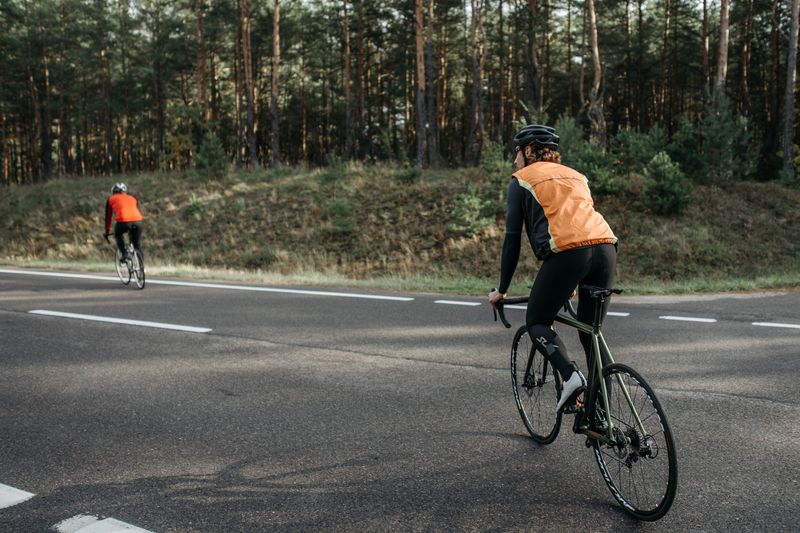
In the saddle, straight arms braced against the bars and a low body position are what riders converge on naturally with practice. It is a physical skill, and reading about it is considerably less useful than doing it twenty times in an empty car park.
Braking on a surface with less grip
On wet, loose or painted surfaces the tyre reaches its limit before the rear wheel lifts, so the wheel skids instead. A skidding front wheel offers no steering and very little braking, and recovering from one is difficult.
Mid-traffic, the response is to brake earlier, more progressively and with more of the effort at the rear than you would on dry tarmac. Braking in a straight line before a corner, rather than while turning, keeps the tyre's grip available for one job at a time.
Rim brakes in the rain have an additional delay while the pads clear water from the rim, which is worth allowing for.
Practising it before you need it
Emergency braking is a reflex, and reflexes are built by repetition rather than by understanding. A quiet car park, a series of stops from moderate speed, and deliberate attention to moving back is the whole exercise.
With a loaded rack, doing it on the machine you actually ride matters, because a loaded commuter behaves differently from an unloaded bike. Repeating it after any change to brakes, tyres or load keeps the calibration current. Twenty minutes of this is one of the highest-value things a rider can do, and almost nobody does it.
Anything structural — forks, steerer, brake mounts — is worth having a mechanic sign off.
The limits of any of this
No braking technique creates space that was not there, which is why following distance matters more than braking skill. A stop that is fast enough on dry tarmac may be nowhere near enough on a wet descent with a loaded bike.
Brakes that are worn, contaminated or poorly adjusted change all of these numbers for the worse. Brakes are safety-critical, so anything spongy, grabbing, fading or noisy is a reason to have them looked at. The most reliable improvement to stopping is riding at a speed and distance that leaves you needing less of it.
The takeaway
Spend twenty minutes in an empty car park finding your bike's braking limit, because the road is a poor place to discover it.
The bike you ride daily beats the better bike you keep indoors.
Questions readers ask
Should I use the front brake in an emergency?
Yes, because that is where most of the stopping power is once weight transfers forward. The skill is moving your weight back as you brake so the rear wheel stays down for longer.
What if the road is wet?
The tyre reaches its grip limit before the rear wheel lifts, so the failure is a skid rather than pitching over. Brake earlier, more progressively, use more rear brake than usual, and do your braking in a straight line.