Safety & Rules
Road Position Is How You Tell a Driver What You Will Do
Where you ride in a lane is not just about safety margin. It is the clearest signal available about your intentions, and drivers read it whether or not they know it.
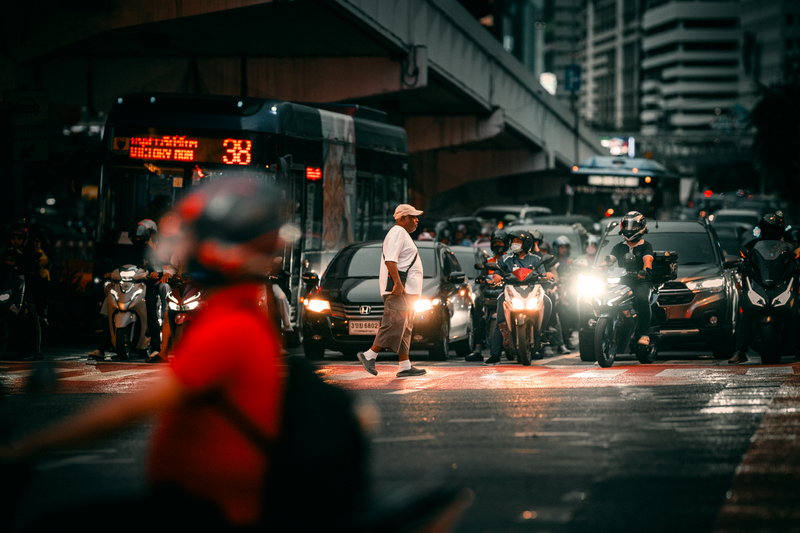
This is less a set of instructions about road positioning than an argument, and it is worth saying so at the start.
The argument in brief
- Riding too close to the kerb invites squeezed overtakes.
- Position should change with hazards, junctions and lane width.
- Local rules on lane use vary; check what applies where you ride.
What position communicates
Drivers make decisions about overtaking based partly on how much space appears to be available beside a rider. A cyclist hugging the kerb creates the visual impression that a car can pass within the same lane, even when it cannot do so safely.
A rider positioned further out removes that impression, so the driver waits for a gap and then overtakes properly into the next lane. This is not about occupying space aggressively, it is about making the available space legible from a driver's seat. Riding techniques taught in national cycle training schemes describe versions of this principle, though the terminology and detail differ between countries.
The hazards near the kerb
The edge of a carriageway collects glass, gravel, wet leaves, drain covers and the worst of the surface damage. Drains and utility covers are often set slightly below the road surface, creating edges that can deflect a wheel. The gutter also gives you nowhere to go if something unexpected happens, since your only escape route is into a kerb.
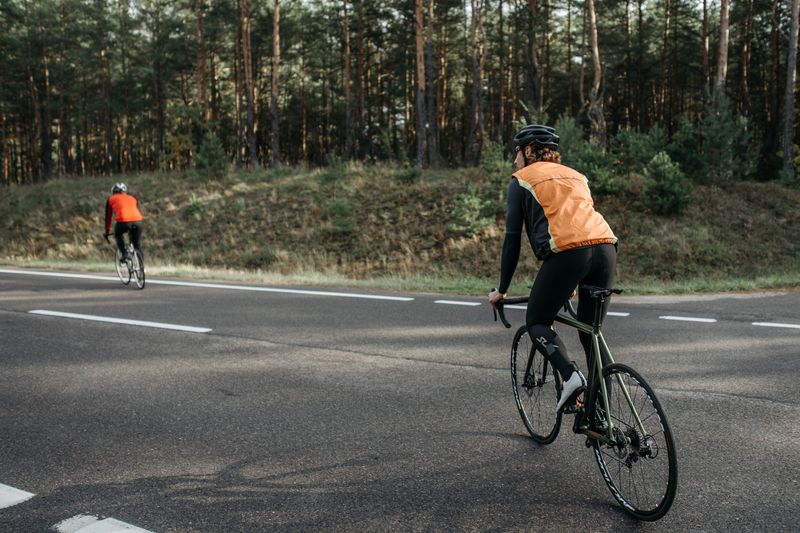
Mid-traffic, riding roughly where a car's nearside wheel track runs puts you on cleaner, better-maintained tarmac. That position also keeps you clear of the door zone beside parked vehicles, which is a separate and more serious hazard.
Moving out and moving back
Position is not a fixed setting, it is something you adjust continuously as the road changes ahead of you. Move further out approaching junctions, narrow sections, pinch points, parked cars and anywhere you do not want to be overtaken. Move back towards the left or right, depending on which side traffic drives in your country, once the hazard has passed and it is safe to be overtaken.
Making that movement early and smoothly gives following drivers time to understand it, whereas a late swerve looks erratic. Looking behind before any lateral movement is what turns a manoeuvre into a communicated intention.
Being predictable
A driver approaching from behind is building a mental model of what you are likely to do in the next few seconds. Steady speed, a straight line and early, visible movements make that model accurate, and an accurate model is what keeps you safe.
Weaving between parked cars into and out of gaps is the most common way riders destroy that predictability without realising. Holding a consistent line past a row of parked vehicles, rather than diving into each gap, is both safer and less tiring.
The same principle applies to speed, since accelerating unpredictably makes it harder for a driver to judge a safe overtake.
Junctions and the case for taking the lane
Approaching a junction where you intend to go straight ahead, riding towards the middle of the lane prevents a vehicle from overtaking and turning across you. It also puts you in the part of the road a driver waiting to emerge is actually looking at, rather than in their peripheral vision. The same applies at roundabouts, where riding near the edge of the lane invites drivers to pass and then exit across your path.
By the second week of riding, this position is temporary and deliberate, and moving back afterwards signals that you are not obstructing anyone unnecessarily. Where rules or local practice differ, the principle to hold onto is being where a driver expects to see a vehicle.
Frames, sizes and riding positions vary enormously; borrow before you buy wherever you can.
Rules differ, so check yours
Whether cyclists may use a full lane, must use a cycle lane where one exists, or may ride two abreast varies considerably between countries. Some jurisdictions specify minimum overtaking distances for drivers passing cyclists, and others leave it to general careless driving provisions.
Cycle lane markings also mean different things in different places, from advisory paint to mandatory separated infrastructure. Read the highway code or equivalent for the country you ride in rather than assuming what applies elsewhere. The underlying principle travels well even when the specific rules do not: be visible, be predictable, and be where you are looked for.
The takeaway
Ride where a driver is looking, hold a straight line, and move early enough that everyone can see you do it.
Fix the small rattle. Every large repair began as one.
Questions readers ask
Is riding in the middle of the lane aggressive?
It is a positioning decision, used at junctions, pinch points and anywhere an overtake would be unsafe. Move back once the hazard has passed so following drivers can pass properly.
Do I have to use a cycle lane if one exists?
That depends entirely on your country, and in some places on the specific type of lane marking. Check your local highway code rather than assuming.