Safety & Rules
Where You Look Decides More Than What You See
A bicycle goes roughly where the rider is looking. That is useful when you are looking at the gap and unhelpful when you are staring at the pothole.

What follows is an argument about visual scanning, and about where the received version of it stops being true.
The argument in brief
- Riders steer towards whatever holds their gaze.
- Looking further ahead buys reaction time no equipment can.
- Scanning is a pattern, not a single glance.
Why the bike follows your eyes
Balancing a bicycle involves constant small steering corrections, and those corrections are guided by where you are looking. Fixing your gaze on an object produces a subtle, continuous steering input towards it that the rider does not notice making.
This is why riders on an empty road end up drifting towards the one obstacle in it, which feels like bad luck and is not. The practical instruction is to look at the space you intend to occupy rather than the thing you intend to miss. It feels counterintuitive at first, because attention is naturally drawn to the hazard, and it becomes automatic with deliberate practice.
Looking far enough ahead
The distance you look ahead sets how much time you have between noticing something and having to deal with it. Riders under pressure tend to look closer, which reduces reaction time exactly when more of it is needed.
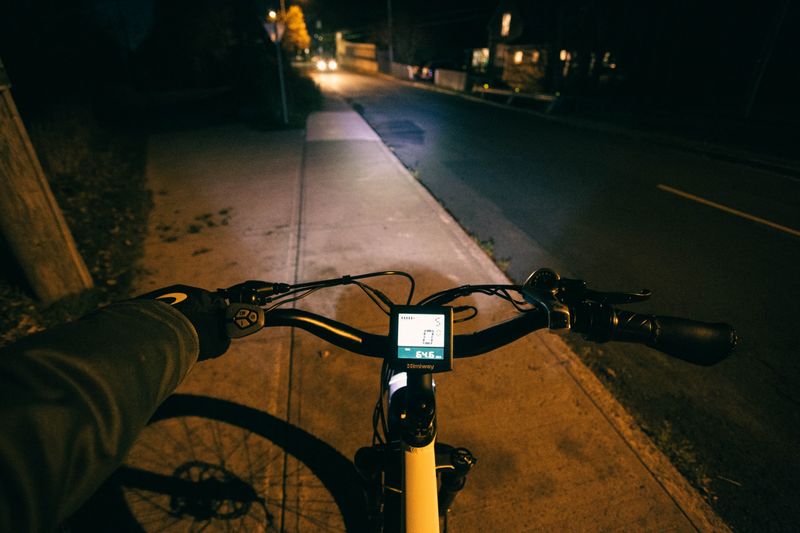
With a loaded rack, looking well ahead also lets you see the shape of the road, the pattern of the traffic and the gap that is opening. It smooths your riding, because you make one early adjustment instead of three late ones. At night, this is limited by how far your light reaches, which is a good argument for a light that illuminates rather than merely signals.
Scanning as a pattern
Useful observation is a repeating cycle rather than a single look, moving between far ahead, near ahead, and behind. The near view covers surfaces and immediate hazards, the far view covers traffic and route, and the rear view covers what is approaching. Establishing a rhythm means nothing is neglected for long, and gaps in the cycle are where surprises come from.
Come the wet months, junctions deserve their own pattern, checking each direction traffic can arrive from before committing. The cycle naturally speeds up in complex situations, which is appropriate, provided it does not collapse into staring at one thing.
Looking behind properly
A glance over the shoulder does two things, giving you information and telling drivers behind that you are aware and probably about to move. That second function is why a deliberate look is more useful than a mirror alone, though a mirror is a genuinely useful supplement. Looking behind without steering into the turn is a skill worth practising somewhere quiet, because it is not automatic.
Mid-traffic, riders who cannot look behind comfortably tend to avoid doing it, which removes the most important observation of all.
Turning the head rather than the shoulders, and keeping the arms relaxed, is what stops the bike following the look.
What attention costs
Attention is limited, and every additional thing you are tracking reduces what is left for anything new. A complex junction, heavy rain and an unfamiliar route together consume most of it before anything unexpected happens.
Come the wet months, conversation, navigation prompts and anything on a screen all draw from the same pool. That is why the same rider handles a familiar commute effortlessly and finds an unfamiliar city exhausting. Reducing the load, by riding a known route or slowing down, is a legitimate response rather than an admission of weakness.
Building the habits deliberately
These are motor skills, which means they improve with practice and decay without it. Practising a shoulder check on a quiet street, repeatedly, until the bike no longer wavers is thirty minutes well spent. Deliberately looking at gaps rather than obstacles for one ride is enough to notice the difference.
Riding a familiar route while consciously extending how far ahead you look shows how much you were missing. None of this requires equipment, and it consistently outperforms equipment in the situations where it matters.
The takeaway
Look at the gap, look further ahead than feels necessary, and practise the shoulder check until the bike stops noticing.
The bike you ride daily beats the better bike you keep indoors.
Questions readers ask
Why do I drift towards the thing I am trying to avoid?
Because you steer towards whatever holds your gaze, through small corrections you do not notice making. Looking at the space you want to pass through, rather than the obstacle, redirects those corrections.
Is a mirror worth fitting?
It supplements a shoulder check usefully, particularly for monitoring traffic continuously. It does not replace one, because a deliberate look also signals to drivers behind that you are aware and may be about to move.