Safety & Rules
Overtaking Distance Is About Turbulence as Much as Space
A vehicle passing close does more than frighten you. It drags air away from one side of you and then pushes it back, and both happen quickly.
Treat the sections below as a sequence. With close passes, getting the early decisions right makes the later ones much easier.
Before you start
- A passing vehicle creates a pressure wave and then a low-pressure wake.
- Larger, faster vehicles produce disproportionately stronger effects.
- Minimum passing distance rules exist in some countries and vary widely.
What moving air actually does to you
A vehicle travelling at speed pushes a mass of air ahead of it, and that air has to move sideways as the vehicle arrives. A rider being passed therefore feels a push away from the vehicle just before it draws level.
Behind the vehicle, air rushes in to fill the space it has vacated, which produces a pull towards the traffic lane. The two effects arrive in quick succession, which is why a close pass can feel like being shoved twice in opposite directions. The rider then makes a corrective steering input, which is how a pass that never touched anything still produces a wobble.
Why size and speed matter so much
The strength of these effects grows sharply with vehicle speed, so the same distance feels entirely different on a fast road. A large flat-fronted vehicle displaces far more air than a car, and it also takes considerably longer to pass. Vehicles towing trailers produce a second, separate disturbance behind the first one, which catches riders out.
A vehicle passing while the rider is already dealing with a crosswind can add to or cancel the wind unpredictably. Distance is the variable that reduces all of it, because the disturbance falls away quickly with lateral separation.
Position and what it communicates
Riding very close to the kerb invites passes within the same lane, because there appears to be room even when there is not. A position further from the edge makes the available width obvious and gives you somewhere to move if a pass is too close.
Come the wet months, it also puts you in a driver's field of view earlier, which is often the difference between being planned around and being noticed late. Riders find this uncomfortable initially because it feels more exposed, and it consistently produces wider passes. On sections where an overtake genuinely cannot be done safely, a position that discourages the attempt until there is space is the standard approach.
The rules, which vary widely
A number of countries have introduced minimum passing distance requirements, often with a larger figure at higher speeds. The distances specified, whether they are law or guidance, and how they are enforced all differ substantially.
Some places have no specified distance at all and rely on general careless driving provisions. Enforcement in several jurisdictions now involves footage submitted by riders, and the acceptance of that evidence varies.
Because the details differ so much, the only reliable approach is to check what applies where you actually ride.
Handling the pass itself
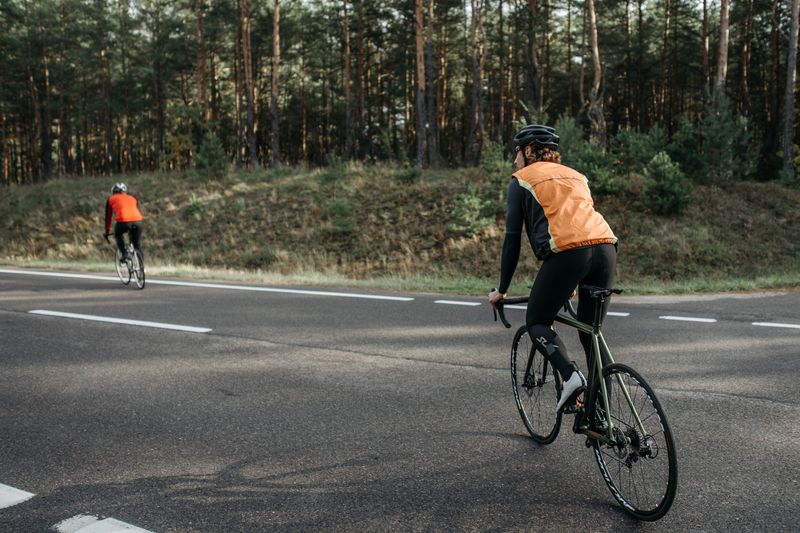
Holding a steady line and a relaxed grip lets the bicycle move slightly under you without turning that movement into a swerve. Tensing up and gripping hard transmits every disturbance directly into steering input, which makes the wobble worse. Looking ahead rather than at the vehicle keeps your line straight, since you steer towards where you look.
The urge to move further left or right as a vehicle passes is worth resisting, because the pass is already committed. Anticipating the wake from a large vehicle, and simply expecting it, removes most of the surprise that causes the correction.
Anything structural — forks, steerer, brake mounts — is worth having a mechanic sign off.
What actually reduces close passes
Physical separation from traffic removes the problem entirely, which is why segregated routes are what most riders ask for. Lower traffic speeds reduce the strength of the effect and widen the margin for everyone, which is why speed limits matter to riders.
Lane widths that make an in-lane pass obviously impossible tend to produce full-lane overtakes instead. Route choice is the tool an individual rider actually controls, and a parallel quiet street is often barely longer. None of this is about assigning fault after the event, because the useful question is which arrangements produce fewer of these moments.
The takeaway
Relaxed hands and a steady line turn a close pass into an unpleasant second rather than a swerve.
The bike you ride daily beats the better bike you keep indoors.
Questions readers ask
Why does a close pass make me wobble even when nothing touches me?
Air is pushed sideways ahead of the vehicle and rushes back in behind it, so you get a shove away and then a pull towards the lane in quick succession. The wobble is usually your own corrective steering input.
Is there a legal minimum passing distance?
In some countries yes, often with a larger figure at higher speeds, and in others there is no specified distance at all. The rules and their enforcement vary a great deal, so check what applies where you ride.