Safety & Rules
Shared Paths Need a Different Set of Habits
A path away from traffic removes one problem and introduces another. People on foot do not have mirrors, indicators or any expectation of you.
This looks at shared path riding from the practical end — what holds up once conditions stop being ideal.
What holds up in practice
- People on foot change direction without warning and are entitled to.
- Approach speed is the variable that determines every outcome.
- Dogs on extending leads occupy the full width of the path.
A different kind of environment
A shared path removes motor traffic, which removes the hazard riders worry about most and replaces it with a set of slower, less predictable ones. People walking do not travel in lanes, do not signal, and are under no obligation to behave predictably. They also cannot see behind them and frequently cannot hear an approaching bicycle at all.
That combination makes approach speed the single variable that determines how every interaction resolves. Riders arriving from the road often carry road speeds onto the path, which is where most of the friction comes from.
Announcing yourself without startling anyone
A bell rung early and gently gives someone time to become aware and drift, which is a completely different event from a bell rung close. A short spoken greeting works better in some contexts, because a voice conveys distance and direction that a bell does not. Slowing down before the interaction removes the need for either, and it is the approach that works regardless.
Assuming that someone has heard you and will move is where the collisions on shared paths originate. Passing at a speed where you could stop if they stepped sideways is the whole of the technique.
Predicting the unpredictable
People turn towards whatever they are looking at, so a head turning is the best available warning of a change in direction. Groups spread across the full width and close up again unpredictably, which is normal behaviour rather than obstruction.
Children move suddenly and in unexpected directions, and they should be treated as a much larger obstacle than they appear. Dogs on extending leads occupy the entire width of the path via a line you may not see until you are close. Headphones are common among walkers too, which means an audible warning may reach nobody at all.
Two-way riding and passing riders
Shared paths carry bicycles in both directions, often on a width designed for far fewer people than currently use it. Blind corners, hedges and bridge approaches are where oncoming riders appear with no warning at closing speeds that combine. Passing another rider requires the same courtesy as passing a walker, since they also cannot see behind them.
Mid-traffic, riders travelling considerably faster than the general flow are the source of most complaints about shared paths.
Where a path is genuinely too busy, taking the parallel road is often better for everyone including you.
Lighting, surface and the conditions
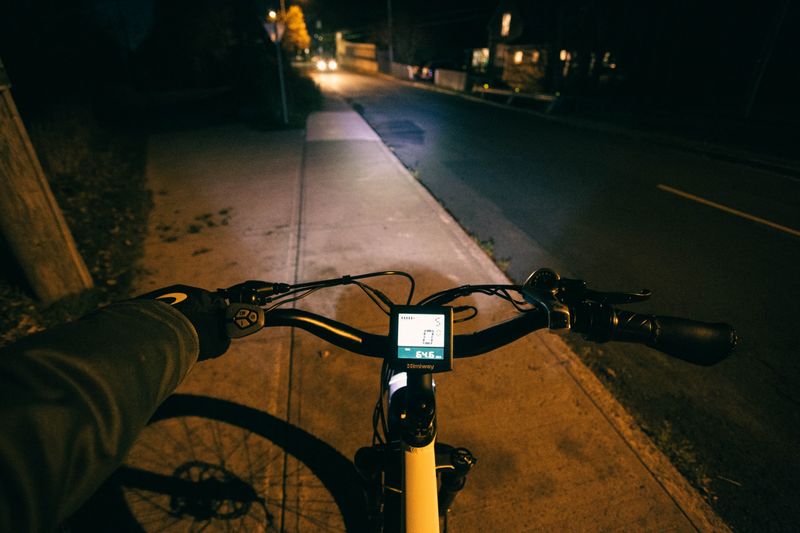
Many shared paths are unlit, and a light that merely makes you visible does not show you the surface at speed. Path surfaces are frequently worse than the road, with roots, gravel, standing water and edges that drop away. Leaves accumulate on paths far more than on roads, and wet leaves are genuinely slippery.
Winter maintenance rarely extends to paths, so ice persists there long after the roads have been treated. All of that argues for lower speeds on paths in poor conditions rather than the higher ones the absence of traffic suggests.
Range and charging figures are quoted under conditions nobody commutes in.
The rules and the reality
Whether cycling is permitted on a given path, at what speed and under what conditions varies by country, city and individual path. Some places have legal priority rules for shared paths, some have advisory codes, and many have neither.
Signage is often absent, contradictory or so weathered that nobody can read it. Where the rules are unclear, riding as though people on foot have priority is both the safest assumption and the one that keeps paths open to bicycles. The reputation of cycling on any given path is built by how the fastest riders behave, which is worth remembering.
The takeaway
Arrive slower than the empty path suggests, because nobody walking has a mirror or any reason to expect you.
Fix the small rattle. Every large repair began as one.
Questions readers ask
Should I use a bell or call out on shared paths?
Either works if it happens early and gently. A bell rung close reads as a demand and produces the sudden sideways step you were avoiding. Slowing down before the interaction works regardless of which you choose.
Who has priority on a shared path?
It varies by country and often by individual path, and signage is frequently absent or unclear. Riding as though people on foot have priority is the assumption that causes the fewest problems and keeps paths open to bicycles.