Maintenance
Why Your Gears Skip and Which Adjustment Actually Fixes It
Indexed shifting fails in a small number of characteristic ways. Each has a distinct symptom, and matching the symptom to the cause saves an afternoon of random adjustment.

This is less a set of instructions about gear adjustment than an argument, and it is worth saying so at the start.
The argument in brief
- Hesitant shifting one way usually means cable friction.
- A bent hanger causes problems that no barrel adjustment will fix.
- Skipping under load with clean shifting suggests worn sprockets.
How indexing works
Each click of the shifter pulls or releases a precise length of cable, which moves the derailleur by a fixed distance. That distance is designed to match the spacing between sprockets, so the chain lands centrally on the next one.
Any friction, slack, misalignment or wear changes the relationship between the click and where the derailleur ends up. The system has no feedback, so it cannot correct itself, which is why small errors produce obvious symptoms. Diagnosis is therefore a matter of working out which part of that chain of cause and effect has drifted.
Hesitation in one direction only
Shifting in one direction is powered by your finger pulling the cable, and in the other by the derailleur's return spring. The spring is much weaker, so friction in the cable and housing affects that direction first and worst.
By the second week of riding, the classic symptom is crisp shifts one way and a delayed clunk the other, often improving briefly after the bike is cleaned. The fix is new inner cables and housings, cut cleanly with square ends and ferrules fitted, rather than adjusting anything. Check that housing loops are generous enough not to kink, since a tight bend at the bars is a common friction source.
Cable tension and the barrel adjuster
If shifting is slightly late in one direction but not sticky, the cable tension is close but not exact. Turning the barrel adjuster anticlockwise increases tension, which moves a rear derailleur towards the larger sprockets. Adjust in quarter turns while pedalling and shifting, working in the middle of the cassette rather than at the extremes.
The bit that actually matters: new cables stretch and settle in the first few rides, which is why a freshly cabled bike often needs a small adjustment afterwards. If a full turn in either direction does not improve matters, the problem is not tension.
The derailleur hanger
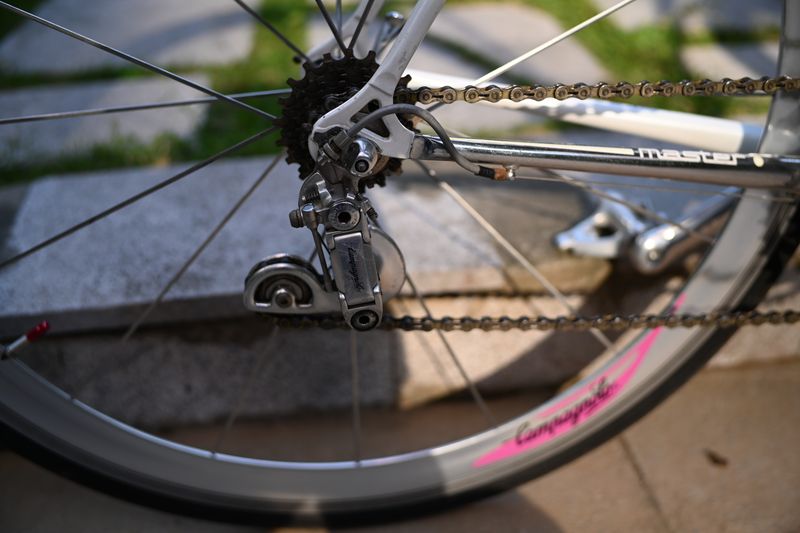
The hanger is the small bracket connecting the rear derailleur to the frame, and it is designed to bend rather than break. A bike that has fallen on its drive side almost always has a slightly bent hanger, even when nothing looks wrong. A bent hanger means the derailleur is no longer parallel to the sprockets, so the spacing between shifts varies across the cassette.
The symptom is shifting that can be set correctly at one end of the cassette and is wrong at the other.
Alignment tools exist, and a shop can straighten most hangers in minutes, which no amount of barrel adjustment will substitute for.
Limit screws and where the chain goes wrong
Two limit screws on each derailleur set how far it can travel inwards and outwards, and they have nothing to do with indexing. If the chain falls off the largest or smallest sprocket, or refuses to reach it, a limit screw is the adjustment. Setting them too tight prevents access to gears you paid for, and too loose risks the chain jamming between cassette and spokes.
Adjust them with the cable disconnected if you want to be certain you are separating the two problems. The B-tension screw, which sets how close the derailleur sits to the sprockets, affects shifting on large sprockets and is often overlooked.
Skipping that is not adjustment at all
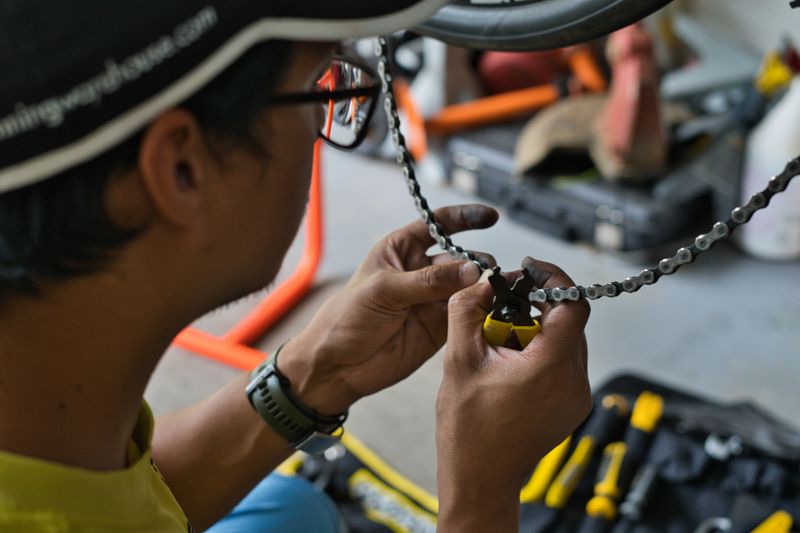
If shifting is crisp but the chain jumps forward under hard pedalling in specific gears, the sprockets are worn. That is the classic outcome of fitting a new chain to a cassette that was ridden with a worn one. A stiff link, caused by a badly joined chain or a bent plate, produces a regular jump once per chain revolution.
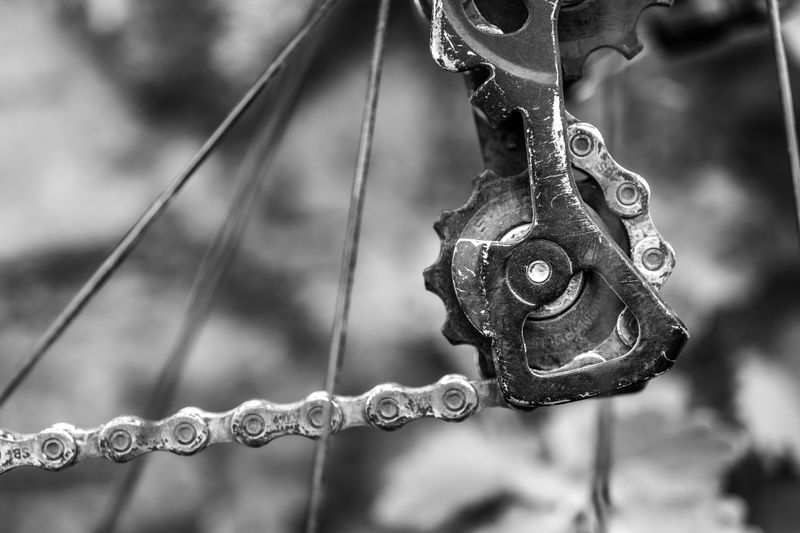
The bit that actually matters: turn the cranks backwards slowly and watch the chain pass through the derailleur to spot a link that does not flex. Worn jockey wheels with hooked teeth also cause noise and imprecision and are cheap to replace.
The takeaway
Match the symptom to the cause: sticky one way means cables, uneven across the cassette means the hanger.
Fix the small rattle. Every large repair began as one.
Questions readers ask
My gears are fine in some sprockets and bad in others. Why?
That pattern usually means a bent derailleur hanger, which changes the spacing across the cassette. It needs aligning rather than adjusting at the barrel.
The chain jumps forward when I pedal hard. Is that indexing?
No. If shifting itself is crisp, a jump under load points to worn sprockets or a stiff link. Check the chain for a link that will not flex, then check sprocket tooth shape.