Riding the City
Protected Cycle Lanes Fail at the Junctions, Not the Straights
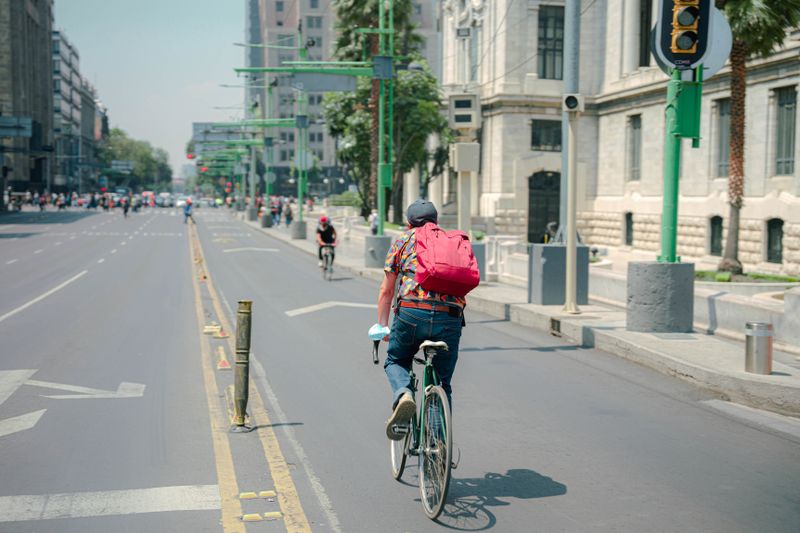
The easy part of building for cycling is the section between junctions. Almost all the design difficulty and almost all the collisions are concentrated where paths cross.
The theory of cycle lane design is well covered elsewhere. This is about the version you meet in practice.
What holds up in practice
- Most urban cycling collisions occur at junctions and accesses.
- Separation between junctions can worsen visibility at them.
- Signal phasing and geometry are the tools that work.
Where collisions actually happen
Studies of urban cycling collisions consistently find that junctions and vehicle accesses account for a large majority of them. That is unsurprising, since a junction is by definition a place where paths that were separate must cross. Building high-quality separation along a straight section therefore addresses the smaller part of the problem.
It can also create a false impression of safety, encouraging higher speeds into a junction that has not been redesigned. The measure of a scheme is what happens at every crossing point, not the quality of the sections between them.
Why separation can make junctions harder
A cycle track set back from the carriageway places riders outside the area a turning driver naturally scans. Drivers checking mirrors and looking over their shoulder are searching the space immediately beside their vehicle. A rider approaching quickly along a set-back track arrives into that space later and from further out.
The same design that reduces risk between junctions can therefore increase it at them without further treatment. This is a well-recognised design problem rather than an argument against separation.
What actually works at a junction
Separating movements in time, using dedicated signal phases for cyclists, removes the conflict entirely at the cost of capacity. Separating them in space, using geometry that forces turning vehicles to cross the cycle path at a near right angle, improves sightlines and slows the turn. Setting the cycle crossing back from the junction gives a turning driver space to stop and look after committing to the turn.
By the second week of riding, tightening corner radii slows turning vehicles, which is one of the most effective single interventions available. Each of these costs road space or signal time, which is why they are contested rather than technically difficult.
Side roads and driveways
Every side road and every vehicle access is a small junction, and there may be dozens along a route. Continuous footway and cycleway treatments, where the path surface and level continue across the side road, make priority visually obvious.
Where the path simply stops and starts again with a give-way marking, riders lose priority repeatedly and the route becomes slow. That slowness is why some experienced riders avoid otherwise good infrastructure and use the carriageway instead.
A route that is safe but constantly interrupted has solved one problem and created another.
Design guidance and its inconsistent application
Several countries publish detailed cycle infrastructure design standards, and the best of them address junctions in depth. Application varies enormously, since schemes are constrained by available space, budget, politics and existing traffic capacity.
By the second week of riding, the commonest failure is a scheme that is built to a good standard where it is easy and abandons it where it is hard. That produces the pattern riders recognise: excellent for a kilometre, then paint, then nothing at the roundabout. Judging a scheme means walking or riding its worst hundred metres rather than its publicity photographs.
Road law for cycles and e-scooters is local, and enforcement is more local still.
What riders can do about it
Consultation processes on schemes are usually open and usually attract more objections than support. Specific, located comments about a particular junction carry more weight than general statements of principle.
Local cycling groups often have the technical knowledge to comment on design details, and joining one is the shortest route into that. Reporting near misses and surface defects builds a record that supports later changes. In the meantime, treat any junction as unprotected regardless of what the paint suggests.
The takeaway
Judge a cycle route by its worst junction, because that is what decides whether people use it.
The bike you ride daily beats the better bike you keep indoors.
Questions readers ask
Why do good cycle lanes end at junctions?
Junctions require road space, signal time or reduced motor capacity to fix properly, all of which are contested. Straight sections are cheaper and less controversial, so they get built first.
Is separated infrastructure always safer?
Between junctions, generally yes. At junctions it depends entirely on how the crossing is designed, since separation can place riders outside a turning driver's normal scanning area.