Safety & Rules
Riding After Dark Changes More Than the Light Level
Lighting is the obvious difference and not the only one. Judgement of speed, driver behaviour and your own tiredness all change once the sun goes down.
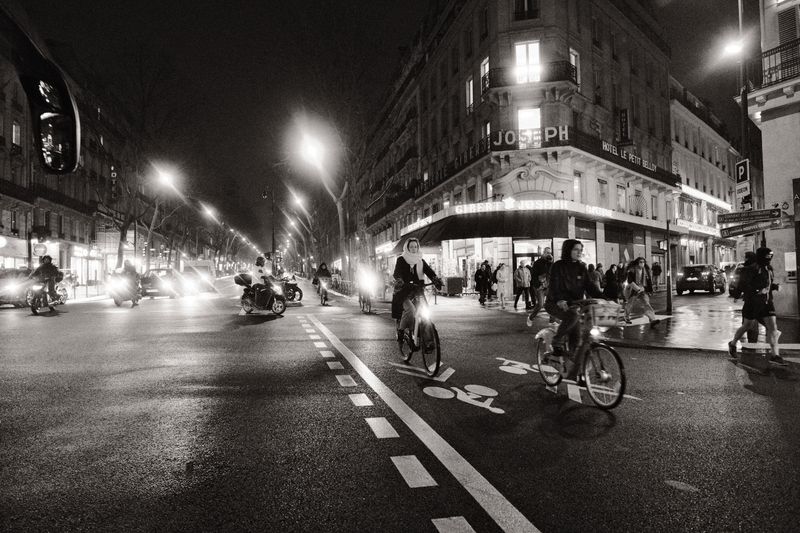
These are listed in the order worth acting on, which with night riding is not the order they are usually presented in.
What matters most
- Depth and speed judgement degrade for everyone at night.
- Glare from oncoming headlights hides hazards near the kerb.
- Route choice at night involves lighting and isolation, not just distance.
What darkness does to human vision
In low light the eye shifts towards rod-dominated vision, which is more sensitive but has poorer acuity and almost no colour discrimination. That degrades everyone's ability to judge distance and closing speed, drivers and cyclists alike.
Contrast sensitivity drops too, which means a dark object against a dark background may not be resolved at all. Older eyes adapt to changing light levels more slowly, which matters when a driver passes from a lit street into a dark one. None of this is a moral failing on anyone's part; it is a limitation to design your riding around.
Glare and the space beside you
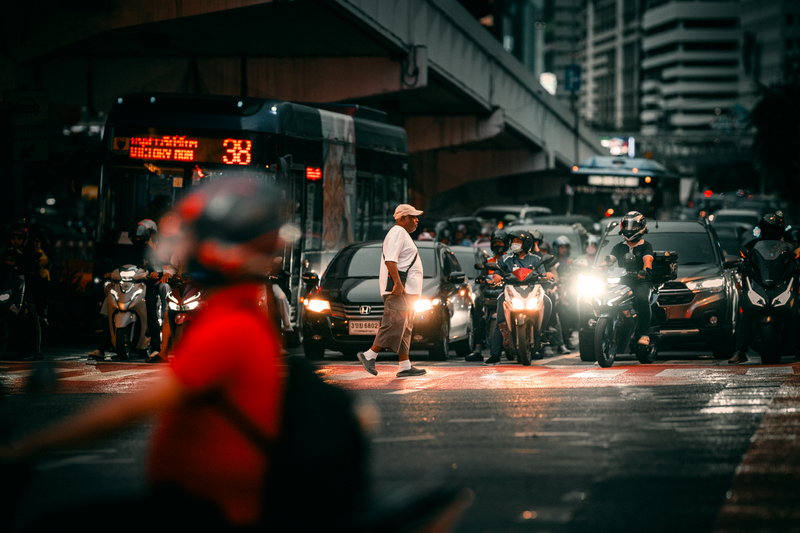
Oncoming headlights create glare that reduces a driver's ability to see anything in the darker areas beside the beam. That darker area is often exactly where a cyclist riding near the kerb is positioned.
In the saddle, it also affects you, since bright oncoming lights make the road surface ahead harder to read for several seconds. Looking slightly away from oncoming lights, towards the edge of your own beam, preserves some adaptation. Riding slightly slower when facing oncoming traffic on an unlit road is the practical response to both problems.
Seeing the surface
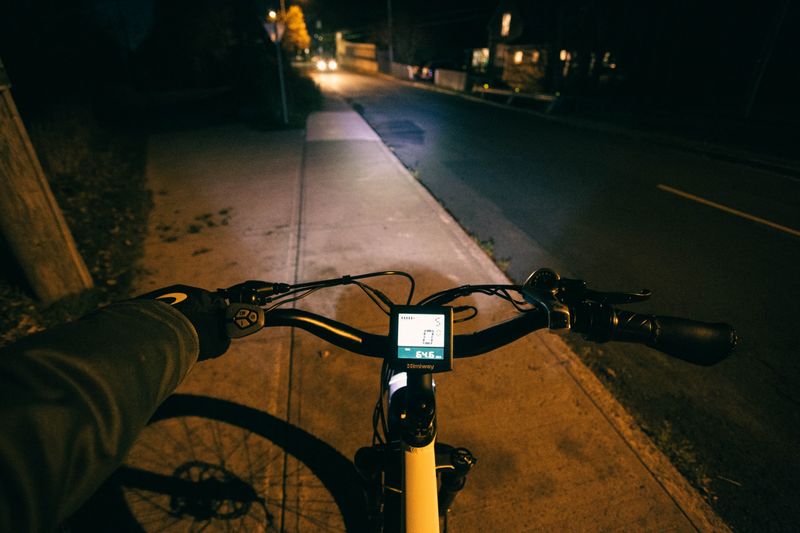
Potholes, debris and wet patches are much harder to identify at night, since shadows and reflections mislead. A front light aimed too high illuminates the horizon and leaves the road immediately ahead dark.
Mid-traffic, aim the brightest part of the beam at the road far enough ahead that you can stop within the lit distance. That distance sets your safe speed at night, which is usually lower than your daytime speed on the same road. Wet roads reflect much of the light away from you, which is why an adequate light in dry conditions can be inadequate in rain.
Driver behaviour changes too
Traffic volumes fall, which encourages higher speeds and reduces the natural calming effect of congestion. The proportion of drivers affected by alcohol, fatigue or distraction rises at certain hours in most places.
Come the wet months, emerging drivers at side roads have less information to work with and are looking for headlights rather than bicycles. That is an argument for stronger positioning at junctions after dark, not weaker. It is also an argument for treating late-night riding as a different activity requiring more margin.
Choosing a route at night
Street lighting changes which routes are comfortable, and a pleasant daytime path can be unlit and isolated after dark. Personal safety is a genuine consideration for many riders and it is reasonable to prefer a busier lit road over a quiet dark path. Surface hazards you know from daytime riding are easier to handle than unfamiliar ones, so familiar routes are better at night.
Tell someone your route and expected arrival if you are riding somewhere remote after dark. Carry a means of contact and enough charge to use it, which is more important at night than at any other time.
Range and charging figures are quoted under conditions nobody commutes in.
Your own condition
Riding home after a long day involves slower reactions and worse judgement than the same ride in the morning. Fatigue affects attention before it affects strength, so you will feel capable while missing things. Cold compounds it, since chilled hands respond slowly and shivering degrades fine control.
In the saddle, eating something before a late ride home is a simple and effective intervention that riders routinely skip. If you are too tired to ride attentively, that is a reason to take another option rather than a test of character.
Everything above, in order of what to do first
- What darkness does to human vision. In low light the eye shifts towards rod-dominated vision, which is more sensitive but has poorer acuity and almost no colour discrimination.
- Glare and the space beside you. Oncoming headlights create glare that reduces a driver's ability to see anything in the darker areas beside the beam.
- Seeing the surface. Potholes, debris and wet patches are much harder to identify at night, since shadows and reflections mislead.
- Driver behaviour changes too. Traffic volumes fall, which encourages higher speeds and reduces the natural calming effect of congestion.
- Choosing a route at night. Street lighting changes which routes are comfortable, and a pleasant daytime path can be unlit and isolated after dark.
- Your own condition. Riding home after a long day involves slower reactions and worse judgement than the same ride in the morning.
The takeaway
Aim the beam at the road, slow to the distance you can see, and give yourself more margin than daylight needs.
The bike you ride daily beats the better bike you keep indoors.
Questions readers ask
How fast should I ride at night?
Slow enough to stop within the distance your light actually illuminates. On unlit roads that is usually noticeably slower than your daytime pace, especially in the wet.
Is a busy lit road safer than a quiet dark path at night?
Often yes, for surface visibility and for personal safety. Route choice at night involves lighting and isolation as much as traffic, and it is reasonable to choose differently than in daylight.