Riding the City
Rain Days Reveal Which Cycle Routes People Trust
Riding falls on wet days everywhere, but it falls least on routes that feel safe, which makes rainfall a useful test of what a network actually offers.

Cycling numbers drop when it rains, which surprises nobody. What is more useful is that they drop by very different amounts on different routes in the same city.
Rain removes the discretionary riders first
Every route carries a mix of people who must make the trip and people who chose the bike among several options. Rain acts on the second group far more strongly than the first.
A route that loses most of its riders in wet weather was carrying mostly discretionary trips. A route that holds its numbers was carrying people who had already committed to the bike as transport.
This makes rainfall an unintentional stress test. The weather does the filtering, and the remaining flow shows which corridors are load-bearing rather than pleasant.
Comfort and confidence decay at different rates
Wet weather makes riding less comfortable everywhere, but it makes riding feel less safe only in specific places. Braking distances lengthen and drivers see less, which matters most where riders share space with traffic.
On a protected lane away from turning movements, rain is mainly a clothing problem. On a painted lane beside fast traffic, it becomes a judgement problem, and more people opt out.
The gap between those two responses is measurable. It tends to be wider than the gap in dry-weather use, which is why wet days separate routes that look similar in summer.
Surfaces change what a route asks of a rider
Smooth asphalt in the wet is manageable. Painted markings, metal covers, tram rails and worn setts all lose grip disproportionately, and routes differ enormously in how many of these they contain.
Drainage compounds it. A lane at the edge of the carriageway collects standing water, and riders must choose between riding through it and moving out into the traffic stream.
Neither problem appears in a dry-weather assessment. Both are obvious to anyone who has ridden the route in November, which is one reason rider feedback and design drawings so often disagree.
Maintenance decides more than design in winter
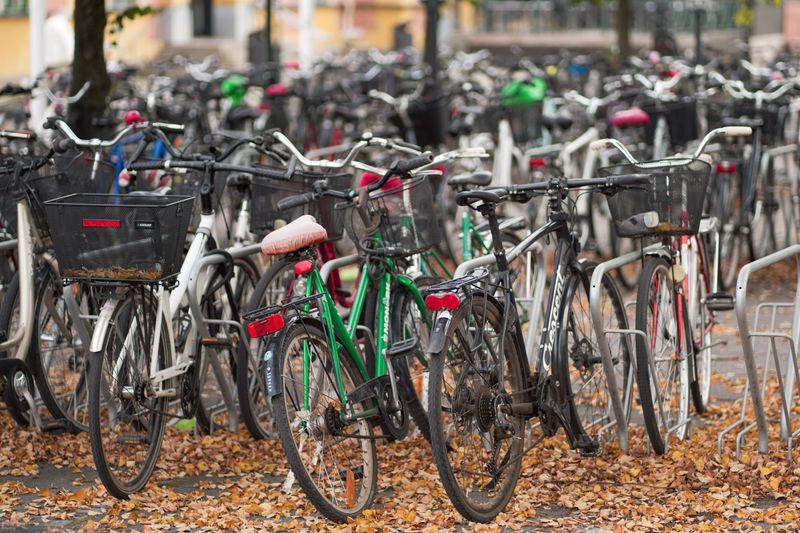
Leaf fall, grit and debris migrate to the edges of roads, which is exactly where cycle lanes are usually placed. A route that is not swept becomes narrower in practice than it is on paper.
Cities that sweep and treat cycle routes on the same schedule as roads see far smaller seasonal drops. The infrastructure has not changed, only whether it remains usable.
This is unglamorous work with no ribbon to cut. It nonetheless does more for year-round riding than a further stretch of new lane in many networks.
Reading the wet-weather figure as a design verdict
A useful question for any completed scheme is what proportion of its dry-weather use survives a wet week. That ratio is cheap to calculate wherever counts already exist.
Routes that retain most of their riders are doing the job. Routes that empty are being used when conditions are forgiving and abandoned when they are not.
Treating that as a signal rather than as weather noise changes what gets fixed. The failure is rarely the rain itself and usually a specific junction, surface or gap that only becomes intolerable when wet.
Questions readers ask
Why do people ride on the road next to a cycle path?
Usually because the path is slower, gives up priority at every side road, or does not go where they are going. Directness is a real requirement, not a preference.
Why does a new cycle route sometimes seem little used?
Often because it does not yet connect to anything at either end. Network value grows as links join up, so early sections can look disappointing until the gaps close.