Riding the City
Street Trees Change Which Routes Get Ridden in Summer
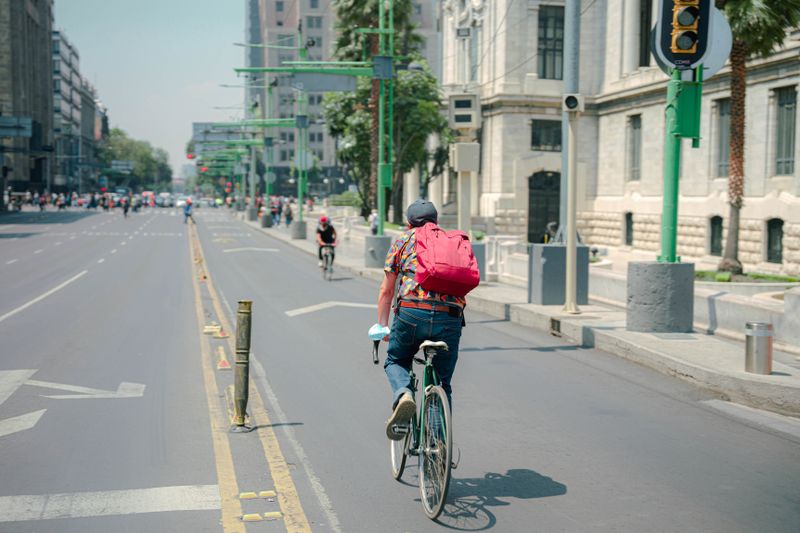
Shade lowers the effective temperature of a ride substantially, which makes tree cover a genuine factor in route choice during hot months and in hot cities year round.

Route choice in summer is not decided only by distance and traffic. In hot weather, shade becomes a factor strong enough to redirect riders onto slower streets.
Radiant heat is a separate load from air temperature
A thermometer in the shade records air temperature. A rider in direct sun is also absorbing radiation, and the heat load is considerably higher than the air reading implies.
Dark road surfaces re-radiate heat upward through the afternoon and evening. A street with asphalt on both sides and no canopy stays hot long after the sun has moved.
Riders feel this as a difference between streets that a weather forecast cannot express. The same city can be comfortable on one road and unpleasant on the next.
Cooling by evaporation stops working in still air
Riding creates its own airflow, which is why moving is more comfortable than standing. That advantage disappears at traffic lights and in slow-moving queues.
Sweat cools the body by evaporating, and the rate depends on air movement and humidity. Stopped in sun with high humidity, the mechanism is doing very little.
This is why waiting time in the heat is disproportionately unpleasant. A route with fewer stops is cooler in practice even when its surfaces are no different.
Canopy structure matters more than tree count
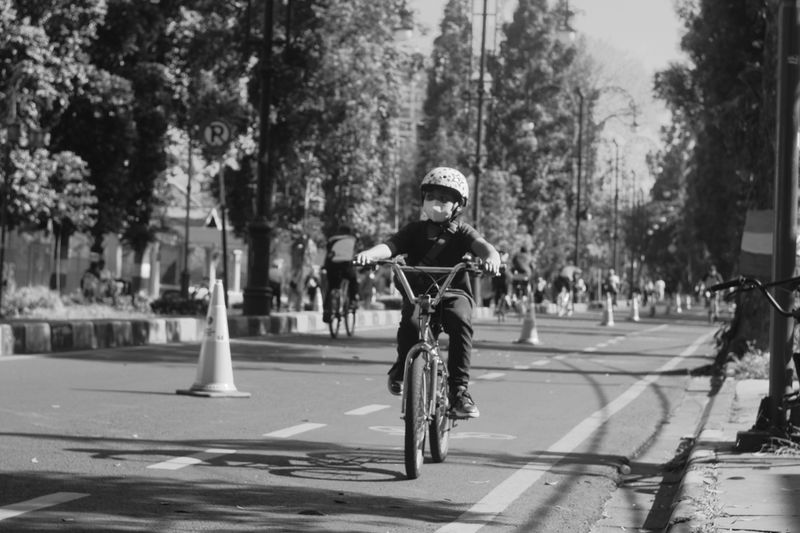
Trees shade a street usefully only when their crowns meet over the carriageway or at least over its edges. Young or heavily pruned trees on a wide road produce very little useful shade.
Species and pruning regime therefore decide the outcome for decades. A street planted with narrow upright forms will never shade the way one planted with spreading crowns does.
Timing matters too, because shade falls where the sun is not. A street running east to west is shaded along one side for most of the day, and that side is the one riders use.
Shade competes with other uses of the same space
Tree pits take road width, and their roots eventually lift adjacent surfaces. Both facts put trees in direct competition with cycle lanes for the same edge of the carriageway.
Poorly placed trees also create their own hazards, dropping fruit, leaves and small branches onto exactly the strip riders use. Maintenance regimes rarely account for this.
The resolution is generally to place the planting between the cycle lane and the motor traffic. It provides shade, physical separation and a visual narrowing of the carriageway at once.
Hot cities show what temperate ones will need
In places where summer riding is already limited by heat, shade provision is treated as basic infrastructure rather than as landscaping. Routes are planned around continuous canopy.
Temperate cities have historically not needed this, and their networks show it. Newer schemes are frequently built on the widest, most exposed corridors available.
As hot spells become a more regular feature of summers, that choice becomes a limitation. A route that is unusable for several weeks a year is not fully doing its job.
Questions readers ask
Why do people ride on the road next to a cycle path?
Usually because the path is slower, gives up priority at every side road, or does not go where they are going. Directness is a real requirement, not a preference.
Why does a new cycle route sometimes seem little used?
Often because it does not yet connect to anything at either end. Network value grows as links join up, so early sections can look disappointing until the gaps close.