Riding the City
The School Run Is the Trip Cities Plan For Last
School journeys are short, concentrated and highly time-constrained, which makes them the trips most sensitive to network gaps and the least well served by commuter-focused design.

School journeys are among the shortest trips a city contains and among the least likely to be made by bike. The reasons are structural rather than a matter of parental preference.
The distance is right and the conditions are not
Most school trips fall within a range a child could ride comfortably. Distance is therefore almost never the constraint, which distinguishes these journeys from most other trip types.
What decides them instead is the worst point on the route. A parent assessing a two-kilometre ride is really assessing the single junction they least want their child to cross.
This is a different calculation from the one a commuter makes. An adult accepts a hostile stretch as the price of a faster journey, while a parent treats it as disqualifying.
Timing concentrates everything into two short windows
School traffic arrives in a narrow band twice a day, which is also when the road network is carrying peak commuter volume. The two loads land on the same streets simultaneously.
Concentration makes the streets outside schools measurably worse than the same streets an hour later. Vehicles stopping, reversing and double-parking create exactly the conditions least suited to inexperienced riders.
The congestion is substantially self-generated. A large share of the vehicles causing it are there to drop off children who live close enough to have arrived another way.
Riding with a child changes the space required
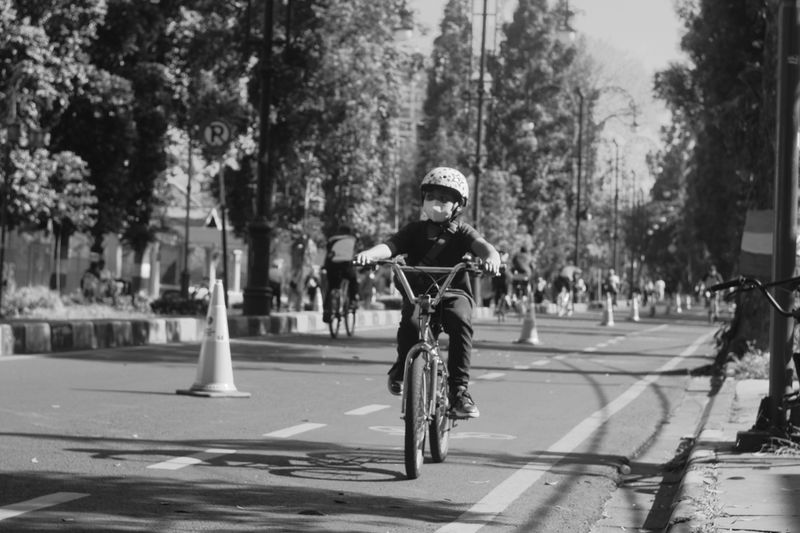
Two riders travelling side by side need width that most cycle lanes do not provide. Riding in single file removes the adult's ability to see and speak to the child.
Children also ride less predictably, and correctly so, because they are still learning to judge gaps. Infrastructure sized for a confident solo commuter does not accommodate that variability.
Cargo bikes and trailers compound the problem. They need turning room, parking space and gentle kerb transitions, none of which feature strongly in networks designed around narrow adult bikes.
School gate interventions work when they are not partial
Closing the street outside a school at opening and closing times changes the environment abruptly. The change is limited to the hours that matter, which keeps the cost of it low.
Its effect depends on the approach routes. If a child must still cross a hostile road to reach the closed street, the calm zone is an island rather than a route.
Cities that treat the closure as the end of the work usually see modest results. Those that extend calming along the streets feeding the school see much larger shifts.
Habits formed here persist long after the trip ends
A child who rides to school learns the road as a rider, at an age when road judgement is being formed. That experience is difficult to acquire later.
Places with high rates of independent child travel tend to have high adult cycling rates a generation on. The relationship runs in both directions and reinforces itself over decades.
Treating school trips as a minor category therefore has long consequences. They are the trips most likely to determine whether the next set of adults treats a bicycle as normal transport.
Questions readers ask
Why do people ride on the road next to a cycle path?
Usually because the path is slower, gives up priority at every side road, or does not go where they are going. Directness is a real requirement, not a preference.
Why does a new cycle route sometimes seem little used?
Often because it does not yet connect to anything at either end. Network value grows as links join up, so early sections can look disappointing until the gaps close.