The Commute
Building a Commute You Will Still Be Doing in November
Most people who stop cycling to work stop in the dark half of the year. The habit survives on the things you set up while it is still easy.

These are listed in the order worth acting on, which with commuting habits is not the order they are usually presented in.
What matters most
- Friction at either end of the journey decides whether the habit holds.
- Lighting and mudguards remove the two most common winter excuses.
- A partial week is more sustainable than an all-or-nothing rule.
Where the habit actually breaks
Riders rarely abandon cycling because a ride was bad; they abandon it after a run of small frictions accumulates. A flat tyre with no pump, a dead light, wet shoes from yesterday and a bike buried behind other things all take a morning each. Each of those makes taking the bus the easier decision on a specific day, and a few such days establish a new pattern.
So the work of keeping a commute going is mostly removing friction rather than summoning motivation. That is convenient, because friction is a practical problem and motivation is not.
The setup that survives winter
Lights that are permanently mounted and charged, or a dynamo system, remove the most common reason to abandon an evening ride. Mudguards mean a wet road no longer produces a soaked ride, which is the single biggest weather-related deterrent. A rack takes the bag off your back, so arriving warm in winter clothing does not mean arriving soaked in sweat.
Somewhere to hang wet gear at both ends means the next morning starts with dry kit rather than a decision. None of this is expensive, and all of it is easier to arrange in September than in December.
Storage and the first two minutes
A bike that must be lifted, unstacked or carried through a hallway adds effort at the exact moment your commitment is weakest. Wherever the bike lives, getting to it and leaving should take under a minute or the friction compounds daily. The same applies at the other end, since awkward parking at work is a reliable predictor of giving up.
Keeping a floor pump where the bike lives means tyres get checked rather than ignored until they are soft. These arrangements sound trivial and they are the difference between three days a week and none.
Partial weeks count
Treating cycling as an all-or-nothing commitment means one missed day feels like a failure and makes the next one easier to miss. Riding two or three days a week is a durable pattern that survives weather, meetings, illness and school runs.
In the saddle, some riders fix specific days, which removes the daily decision entirely and is why it works. Others ride one way and take transport the other, which halves the exposure while keeping most of the benefit. Any of these beats an ambitious rule abandoned in week three.
Dark mornings and what changes
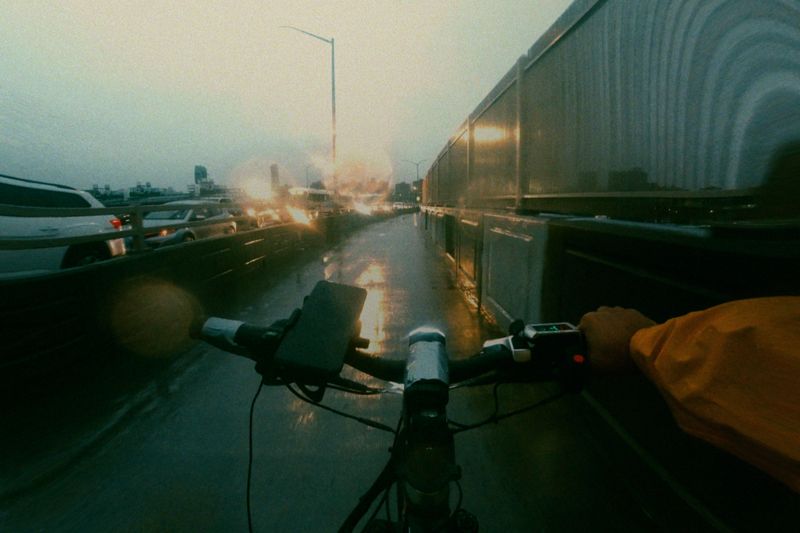
Darkness reduces how well drivers can pick you out, which is why lighting and reflective placement matter more than in summer. It also changes which routes feel acceptable, since a path that is pleasant in daylight may be poorly lit and isolated at night.
Having a winter variant of your route, chosen for lighting and passing traffic, is worth working out in advance. Cold, wet and dark together are harder than any of them alone, which is why late autumn is when most riders stop. Knowing that the difficult period is a few weeks rather than a season makes it easier to ride through.
Keeping the bike working
Winter wears drivetrains and brakes far faster, and a bike that shifts badly and stops poorly is an unpleasant thing to ride. A service before winter rather than after it means the bike enters the hard months in good condition. A weekly wipe-down of chain and rims takes minutes and prevents most of the deterioration.
With a loaded rack, learning to fix a puncture at the roadside removes the fear that a flat means an abandoned bike and a long walk. A bike that works reliably is a bike you keep choosing, which is the whole of the problem.
Everything above, in order of what to do first
- Where the habit actually breaks. Riders rarely abandon cycling because a ride was bad; they abandon it after a run of small frictions accumulates.
- The setup that survives winter. Lights that are permanently mounted and charged, or a dynamo system, remove the most common reason to abandon an evening ride.
- Storage and the first two minutes. A bike that must be lifted, unstacked or carried through a hallway adds effort at the exact moment your commitment is weakest.
- Partial weeks count. Treating cycling as an all-or-nothing commitment means one missed day feels like a failure and makes the next one easier to miss.
- Dark mornings and what changes. Darkness reduces how well drivers can pick you out, which is why lighting and reflective placement matter more than in summer.
- Keeping the bike working. Winter wears drivetrains and brakes far faster, and a bike that shifts badly and stops poorly is an unpleasant thing to ride.
The takeaway
Sort the lights, the guards and the storage in September, and November takes care of itself.
Most of riding well is being boring and predictable to everyone else on the road.
Questions readers ask
How do I keep cycling through winter?
Remove friction before it arrives: permanent lights, mudguards, a rack, easy storage and somewhere to dry kit. Motivation fails; a setup that takes one minute does not.
Is it worth cycling only some days?
Yes, and it is more durable than an all-or-nothing rule. Fixed days remove the daily decision, which is what usually erodes the habit.