Safety & Rules
A Blocked Bike Lane Forces a Merge Nobody Planned
Delivery vehicles stopped in a bike lane push riders into a moving traffic lane at an unpredictable point, which is the least safe merge available.

A bike lane occupied by a stopped vehicle is worse than no bike lane at all in one specific way. It forces a merge at a location neither the rider nor the drivers behind had any reason to anticipate.
The merge is unplanned on both sides
A rider approaching an obstruction must move left into a lane carrying traffic that is moving faster and has been treating the bike lane as somebody else's space.
Because the obstruction is temporary, no signage, marking, or taper exists to warn drivers that a merge point has appeared.
The rider is therefore making a lateral movement at an arbitrary point, which is exactly what road design normally works to avoid.
Sight lines fail at the moment of the decision
A parked delivery van is tall and wide, so a rider behind it cannot see forward and drivers approaching cannot see the rider until the moment of emergence.
The rider's decision to merge has to be made from behind the obstruction, using a shoulder check into a lane whose contents are partly hidden.
Doors on the passenger side add a second hazard in the same place, since curbside loading means people stepping out toward the bike lane.
The economics explain the persistence
Commercial delivery volumes in American cities have risen substantially, while curb space allocated for loading has largely not.
A driver making many stops per hour weighs a possible citation against the time cost of finding legal parking, and the arithmetic usually favors stopping in the lane.
Enforcement that is occasional therefore functions as a modest fee rather than a deterrent, which is why the behavior is stable.
Design responses target the curb, not the driver
Cities addressing this seriously convert parking to timed loading zones near delivery-heavy blocks, so a legal option exists within a short walk of each destination.
Physical separation helps only when it also prevents entry, since a painted buffer or flexible post line is routinely driven over or parked across.
Placing the bike lane at sidewalk level, or behind a parking lane with a hard curb, removes the option of stopping in it entirely.
Handling one as a rider
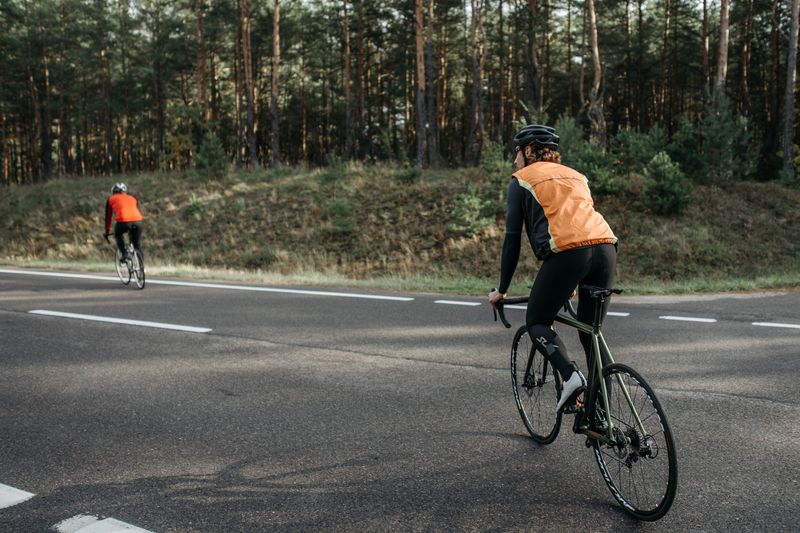
The safest merge is early and gradual, begun well before the obstruction while the rider is still visible and there is room to abort.
Signaling and taking a clear position in the traffic lane communicates the intention, whereas swerving out at the last moment communicates nothing until it is done.
Passing on the right, between the vehicle and the curb, is the option that removes both escape room and visibility at once.
Questions readers ask
Is it worth reporting a near miss if nobody was hurt?
Where a scheme exists, yes, because clusters of reports at one location are what supports a case for changing it. Where none exists, reporting the location to the road authority is still the mechanism that gets a design looked at.
What should I write down after a near miss?
Location, time, direction of travel, what the road looked like and what restricted anyone's view. Photographs of the location taken later are more useful than a description. Skip the part about whose fault it was.