Safety & Rules
Buses Are the Vehicle Riders Most Often Misread
A bus stops where you least expect it, pulls out into your line and hides everything happening in front of it. All three are predictable.
This is written to be used rather than admired. Each section below is a decision about riding around buses, and each one has a default.
Before you start
- A bus at a stop will pull out again, and it needs the lane to do it.
- Passengers step out from in front of and behind a stopped bus.
- Overtaking a bus that is about to move is the conflict that recurs.
Why the interaction repeats
A bus and a bicycle travel at similar average speeds in a city, because the bus is faster between stops and stationary at them. That produces a leapfrogging pattern where you pass a stopped bus, it passes you, and then it stops again ahead of you. Each cycle of that pattern involves an overtake, which is the manoeuvre with the most potential for conflict.
The pattern is entirely predictable, which means it can be planned for rather than reacted to. Recognising that you are in a leapfrog is the first step, because it changes the decision from moment to moment into a strategy.
Passing a stopped bus
A bus at a stop occupies the lane, so passing it means moving out into the traffic stream alongside. That requires looking behind properly and moving out in one decisive movement rather than drifting. Passing close alongside a bus that is about to pull out is the version of this that goes wrong.
The bit that actually matters: indicators, a closing door, an engine note change and the driver's mirror position are all available warnings. The alternative, which is often better, is to wait behind and let the bus go, particularly if the stop is nearly finished.
The people you cannot see
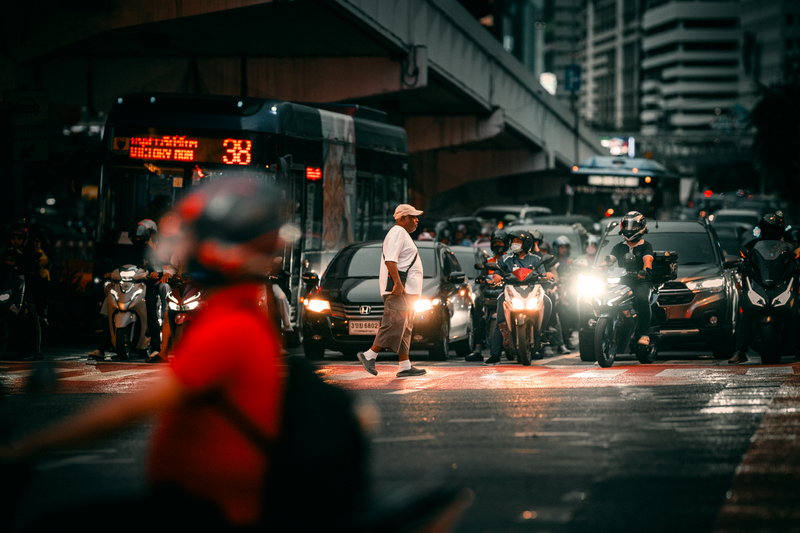
Passengers cross the road in front of and behind a stopped bus, and they emerge with no view of what is coming. The bus blocks their view of you as completely as it blocks your view of them.
That is why passing a stopped bus at speed is a poor idea regardless of how much room is available. The same applies on the door side, where people step directly off the bus into the space you might be riding through. Slowing to a speed where you could stop for someone appearing suddenly is the whole of the technique here.
Being passed by a bus
A bus overtaking a bicycle needs considerable space and a considerable time, because it is long and it is not quick. It then needs to return to the lane, and if there is a stop ahead it will need to do so promptly. That produces the situation where you are overtaken and then immediately cut across, which feels aggressive and is usually geometry.
By the second week of riding, riding a position that makes clear whether there is room to pass, rather than hugging the edge, reduces the number of marginal overtakes.
On narrow sections, taking a position that discourages an overtake until there is space is the standard approach and is uncomfortable until it is habitual.
Bus lanes and shared space
Many cities permit bicycles in bus lanes, which removes general traffic and leaves you sharing with large vehicles. That is often calmer, because there are fewer vehicles and the drivers are professionals who see riders constantly. It also concentrates the leapfrogging, since every bus in the lane will pass you and stop ahead of you repeatedly.
Come the wet months, whether bicycles may use a bus lane, and at what times, differs between cities and is usually signed rather than universal. Where the lane is wide enough for a bus to pass a bicycle it works well, and where it is not it can be worse than the general lane.
Making yourself easy to plan around
Bus drivers are working to a timetable and making constant judgements about whether to pull out. A rider whose speed and position are steady is easy to include in that judgement, and one who is unpredictable is not.
Hanging in a blind spot alongside a bus for any length of time removes you from the driver's picture entirely. Making eye contact through a mirror is useful when it happens and is not something to rely on. The most effective single habit is deciding early whether you are passing or waiting, and then doing that clearly.
The takeaway
Decide early whether you are passing the bus or letting it go, because the worst outcomes come from deciding halfway.
The bike you ride daily beats the better bike you keep indoors.
Questions readers ask
Should I overtake a bus at a stop or wait?
It depends on whether the stop is beginning or ending and whether you can pass with room. If the doors are closing or the indicator is on, waiting is the better choice. Passengers crossing in front of the bus are the hazard you cannot see.
Are bus lanes safer for cycling?
Often calmer, because there is less traffic and the drivers see riders constantly. Whether bicycles may use them varies by city and by time of day, and a lane too narrow for a bus to pass a bicycle can be worse than the general lane.