Safety & Rules
Low Sun Is a Visibility Problem in Both Directions
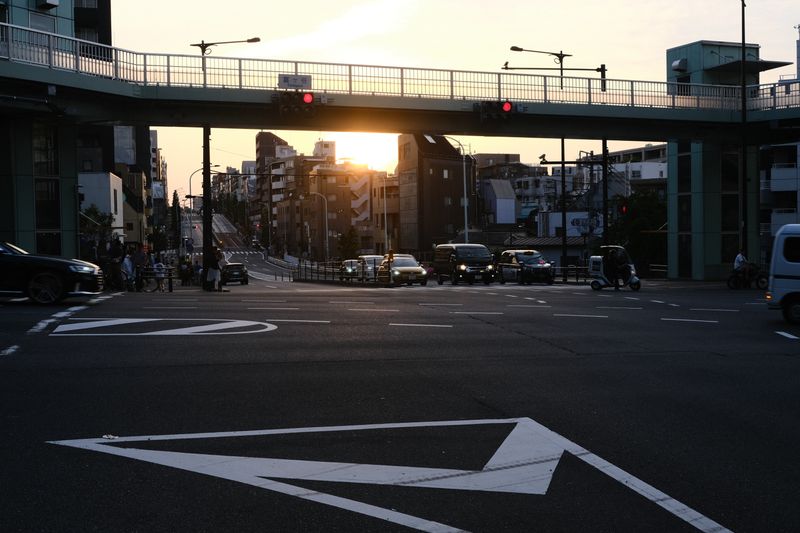
A sun close to the horizon blinds drivers looking toward it and washes out riders lit from behind, which concentrates risk into predictable hours and orientations.

Twice a year, the sun sits low during the hours people commute. The effect on visibility is severe and it is highly predictable in both time and direction.
Glare removes contrast rather than dimming the scene
Light entering the eye at a shallow angle scatters inside it, raising the brightness of the whole field. Objects do not become darker; the background becomes brighter.
Vision depends on contrast, so a rider ahead of a driver looking into the sun can be effectively invisible while remaining fully illuminated.
A dirty or scratched windscreen multiplies the scattering considerably. This is why the effect is far worse in some vehicles than others under identical conditions.
Riding with the sun behind you is the dangerous case
The instinct is that facing into the sun is worse, because that is when the rider is dazzled. The greater risk is the reverse.
With the sun behind, the rider is silhouetted against a bright sky and is seen by drivers who are looking directly into the glare.
Oncoming traffic and vehicles emerging from side roads are both looking that way. Junctions are where this concentrates.
The geometry is predictable enough to plan around
Near the equinoxes the sun rises and sets close to due east and due west. A commute running east to west therefore faces the problem at both ends of the day.
Streets aligned on that axis are the ones affected. A route that turns onto a north-south street for the worst section removes the exposure entirely.
The window is roughly the first and last hour of daylight and lasts a few weeks. Knowing when it applies makes a temporary route change worthwhile.
Daytime lights work here in a way they usually do not
Lighting during daylight is often dismissed as unnecessary. In glare conditions it addresses the mechanism directly, adding a point source against a washed-out background.
A flashing front light is particularly effective, because movement attracts attention where contrast alone has failed. This is one of the clearest cases for daytime running lights.
Rear lighting matters for the same reason when the sun is behind approaching traffic. Both ends of the bike need it at different times of day.
Riding into the sun requires different adjustments
The rider facing the sun loses detail of the road surface and cannot judge potholes or debris. Speed has to come down for reasons unrelated to traffic.
A peaked cap or a helmet visor blocks the direct light far more effectively than sunglasses alone, because the problem is light entering from above the field of view.
Where the glare is total, moving to a position where a building or a row of trees shades the road is the only real remedy. It is worth planning rather than improvising.
Questions readers ask
Is it worth reporting a near miss if nobody was hurt?
Where a scheme exists, yes, because clusters of reports at one location are what supports a case for changing it. Where none exists, reporting the location to the road authority is still the mechanism that gets a design looked at.
What should I write down after a near miss?
Location, time, direction of travel, what the road looked like and what restricted anyone's view. Photographs of the location taken later are more useful than a description. Skip the part about whose fault it was.