Safety & Rules
Right Turn on Red Is a Bicycle Problem
Permitting drivers to turn right at a red light creates a conflict with riders and pedestrians crossing legally, and the mechanism is where the driver is looking.

Turning right at a red light is permitted across most of the United States unless a sign forbids it. The rule is efficient for traffic flow and awkward for anyone crossing in front of the turning vehicle.
The maneuver requires looking away from the conflict
A driver preparing to turn right on red is searching for a gap in traffic approaching from the left, so the head turns in that direction and stays there.
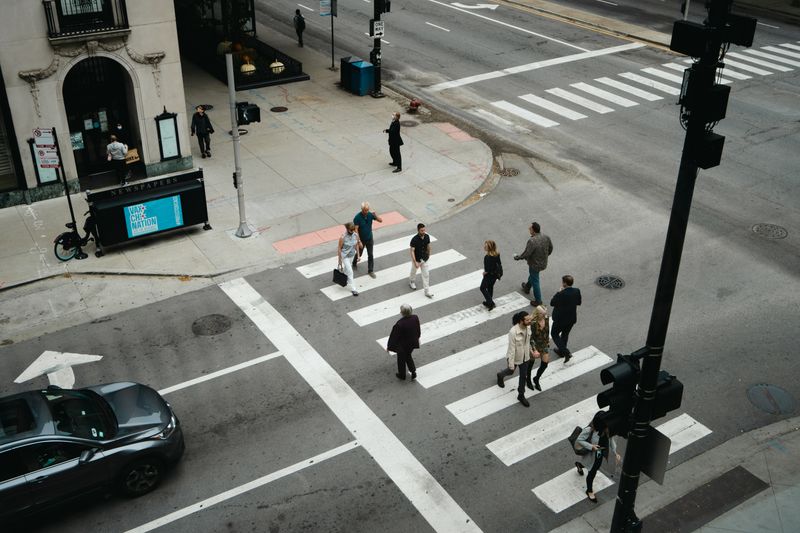
The conflict, meanwhile, is on the right and ahead: a rider in a bike lane, a pedestrian in the crosswalk, or someone approaching along the curb line.
The driver's attention and the hazard are on opposite sides of the vehicle, which is the core of the problem rather than a lapse by any individual.
Creeping forward moves the vehicle into the crossing
To see past parked cars or a building line, drivers commonly roll forward until the front of the vehicle is inside the crosswalk or bike lane.
That improves their view of approaching traffic and simultaneously blocks the space that people crossing are supposed to use.
A rider then has to pass either behind the vehicle or around its front into the intersection, and both options are worse than the marked path.
The launch is the dangerous moment
Once a gap appears, the driver accelerates promptly because the gap is closing. The eyes may return forward only after the vehicle is already moving.
A rider arriving in that window is entering the space during the fraction of a second when nobody is looking at it.
This is why the risk concentrates at signals with heavy right-turn volumes rather than being spread evenly across a route.
Countermeasures change the timing rather than the rule
Agencies commonly use no-turn-on-red signs at the worst locations, and some cities have applied them broadly across a downtown area.
Other treatments separate the movements in time: a leading interval that starts pedestrians and riders before the parallel green, or a fully protected turn phase.
Setting back the stop line, hardening the corner to slow the turn, and improving sight lines all reduce the severity of what remains.
What a rider can do about it
The reliable signal is the front wheel of the waiting vehicle, since it begins to move before the body of the car does and before any indicator changes.
Positioning where a driver's mirror and window cover you, rather than in the blind quarter behind the door pillar, makes being seen more likely.
Rules and signage differ between states and cities, so the local traffic code is the authority on what is permitted at any specific intersection.
Questions readers ask
Is it worth reporting a near miss if nobody was hurt?
Where a scheme exists, yes, because clusters of reports at one location are what supports a case for changing it. Where none exists, reporting the location to the road authority is still the mechanism that gets a design looked at.
What should I write down after a near miss?
Location, time, direction of travel, what the road looked like and what restricted anyone's view. Photographs of the location taken later are more useful than a description. Skip the part about whose fault it was.