Safety & Rules
Rural Roads Are a Different Risk Than City Streets
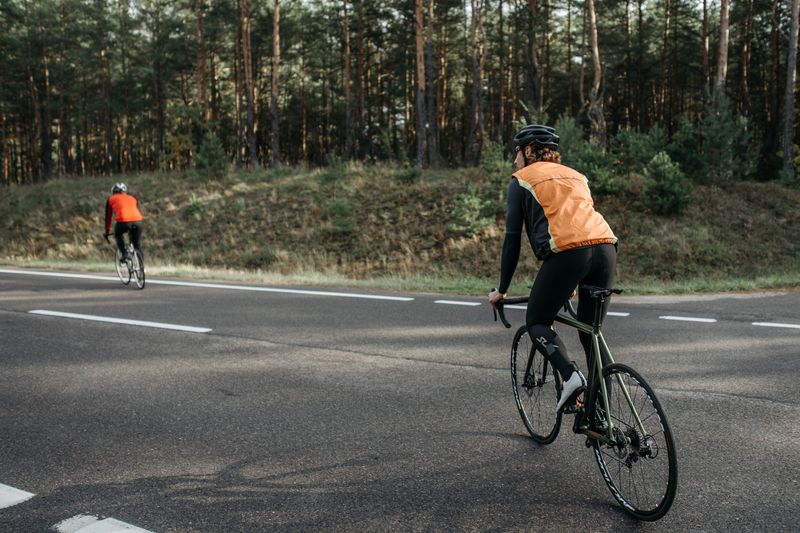
Country riding replaces frequent low-speed conflicts with rare high-speed ones, and the changes in sight distance, shoulder width and response time follow from that.

Riding out of town changes the shape of the risk rather than its size. Conflicts become rare, and each one becomes far more consequential because of speed.
Speed differential sets the severity
A rural highway carries traffic at speeds well above urban limits, so the closing speed between a vehicle and a rider is large.
Available reaction distance shrinks in proportion, and the energy involved in any impact rises steeply with speed.
The practical result is that a rural route with very few vehicles per hour can still present a higher consequence per encounter than a busy city street.
Sight distance is the variable that changes most
Rural alignments include crests and curves designed around vehicle stopping distances at the posted speed, with a rider assumed to be traveling far faster than they are.
A rider just over a crest can be invisible until a driver is close, and the geometry offers no warning to either party.
Choosing routes with open sight lines, and avoiding being stopped just beyond a crest or inside a blind curve, addresses the largest part of this.
Shoulders vary without warning
Rural shoulders change width, surface, and condition at jurisdictional boundaries and between maintenance sections, often with no transition.
A wide paved shoulder can end in gravel, a rumble strip, or a drop-off at the pavement edge, all of which are hazardous to a narrow tire at speed.
Rumble strips in particular can occupy the usable width, forcing riders into the travel lane at exactly the locations where they were installed because of a problem.
Help is further away
A mechanical failure or an injury in open country means a longer wait, and cellular coverage is not uniform across rural areas.
Carrying the means to fix common failures, water for the distance, and a way to be located matters more than it does within a city.
Telling someone the intended route and expected return time is the low-effort version of the same precaution.
Animals, machinery, and surfaces behave differently
Farm equipment travels slowly, is very wide, and turns into field entrances without the geometry a road junction would have.
Loose dogs, deer, and other wildlife are real hazards on quiet roads, particularly around dawn and dusk when they are most active.
Surfaces carry mud, gravel, and crop debris pulled onto the pavement from field entrances, which reduces grip in patches rather than uniformly.
Questions readers ask
Is it worth reporting a near miss if nobody was hurt?
Where a scheme exists, yes, because clusters of reports at one location are what supports a case for changing it. Where none exists, reporting the location to the road authority is still the mechanism that gets a design looked at.
What should I write down after a near miss?
Location, time, direction of travel, what the road looked like and what restricted anyone's view. Photographs of the location taken later are more useful than a description. Skip the part about whose fault it was.