Maintenance
Grease, Anti-Seize and Which One Belongs Where
Bicycles use several distinct lubricants for different jobs, and the common failures come from using a general-purpose product where a specific one was required.
A workshop shelf accumulates several tubes that all look similar. They are formulated for different jobs, and substituting one for another causes predictable problems.
Bearing grease is designed to stay put under load
Grease is oil held in a thickener, which keeps it in place where a liquid would be squeezed out. That is its entire purpose in a bearing.
It also excludes water and contaminants by physically filling the space around the rolling elements. A bearing packed with grease resists ingress far better than one lightly oiled.
The consequence is that grease belongs in bearings and hubs and nowhere that needs to slide freely. It is too viscous for anything that moves quickly over a distance.
Anti-seize prevents metals from bonding, not from wearing
Anti-seize compounds carry solid particles that sit between two surfaces and prevent direct contact. They are used on threads and interfaces that are assembled and rarely moved.
Their job is preventing galling and corrosion between dissimilar metals, which is what seizes seatposts, pedal threads and bottom bracket shells.
They are not lubricants in the bearing sense and should not be used where continuous motion occurs. On a static interface they can remain effective for years.
Chain lubricant has to penetrate and then stay
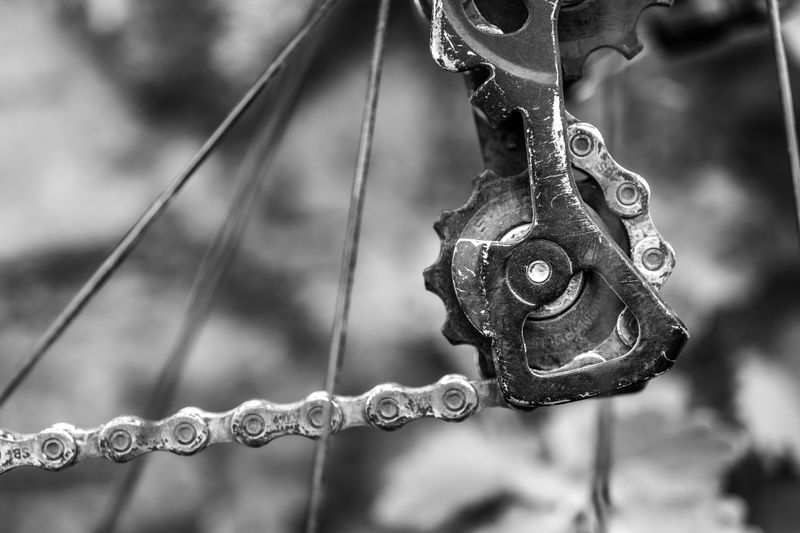
A chain's wearing surfaces are inside the rollers, which means the lubricant has to be thin enough to get in there before it does any work.
Once inside, it needs to resist being flung off and washed out. This is why chain lubricants are formulated as carriers that evaporate, leaving the lubricant behind.
Grease on a chain fails on the first requirement. It sits on the outside collecting grit and never reaches the surfaces that are actually wearing.
Carbon assembly paste does the opposite of lubricating
Where a carbon seatpost meets a frame, the requirement is to hold at low clamping force, because high force damages the tube.
Assembly paste contains particles that increase friction between the surfaces. Grease here reduces friction and causes slipping, which riders then over-tighten to solve.
This is the most common damaging substitution. The correct product does the opposite of what the intuitive choice does.
Threadlock is a chemical, not a lubricant
Threadlocking compounds cure in the absence of air between threads, bonding them until enough torque is applied to break the bond.
They are specified in strengths, and using a permanent grade where a removable one was intended makes future disassembly destructive.
They also require clean, dry threads. Any oil or grease present prevents curing, which is why applying both to the same fastener achieves neither.
Questions readers ask
My steering feels notchy in the straight-ahead position. What is that?
An indented headset bearing race, usually caused by riding with a loose headset. The notch cannot be polished out, so the bearing needs replacing, and the adjustment needs correcting afterwards.
How long should bearings last?
It depends far more on water and grit than on distance. A bike with mudguards and dry storage can go years; one ridden through salted winters without guards may need attention annually.