Maintenance
Rust, Seized Bolts and the Parts That Weld Themselves Together
Two metals left touching in damp air slowly become one part. The repair you postpone becomes the repair that needs a workshop and heat.
Everything below about seized components comes from what actually happens rather than from what is supposed to.
What holds up in practice
- Dissimilar metals in contact with moisture corrode faster than either alone.
- Grease and anti-seize work by keeping water out of the joint.
- A seized seatpost or stem is often beyond a home workshop.
Why metals stick to each other
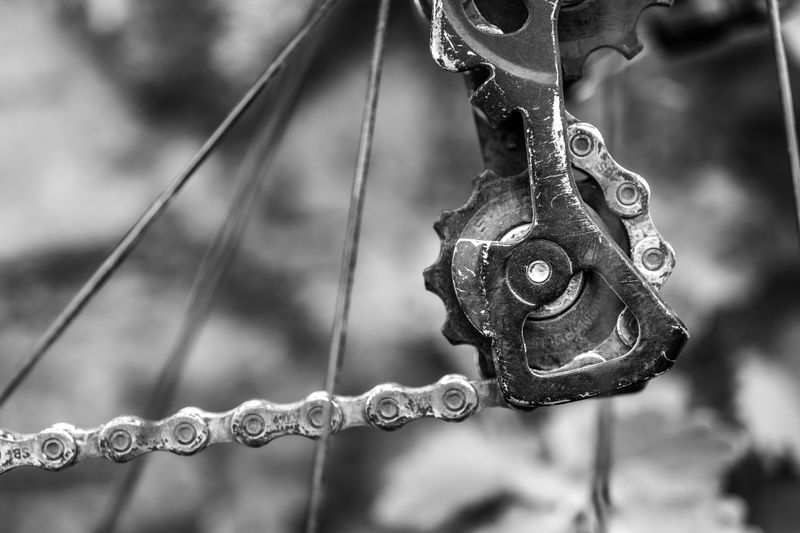
Corrosion needs a metal, an electrolyte such as salty water, and usually a second metal at a different electrical potential. Bicycles supply all three routinely, since an aluminium seatpost sits inside a steel frame and the whole assembly rides through rain. The corrosion product that forms between the two surfaces takes up more space than the original metal did.
That expansion is what physically locks the parts together, which is why the joint gets tighter rather than looser over time. Once it has started, the process accelerates, because the growing layer holds moisture against both surfaces indefinitely.
The joints that seize most
Seatposts inside frames are the classic case, because the joint is vertical, water runs into it and nobody moves it for years. Quill stems inside steerer tubes are the same problem in a place where the consequences of a botched removal are worse. Pedal threads into crank arms seize readily, and one of them has a left-hand thread, which produces a great deal of confusion.
Bottom bracket threads, disc rotor bolts and rack fasteners all sit in exposed positions and are frequently left untouched for years. Anything that has not been removed since the bicycle was assembled is a candidate, particularly on a machine ridden through salted winters.
Grease is a barrier, not a lubricant, here
The reason to grease a seatpost is not to help it slide but to keep water out of the gap between the two metals. A thin film of grease on the post, the pedal threads and the stem does more for long-term serviceability than almost any other habit. Anti-seize compounds go further by adding solid particles that keep the surfaces physically separated.
By the second week of riding, carbon components are the exception, since some greases affect resins and carbon frames normally want a specific assembly paste instead. Whatever is used, the important part is that the joint is disturbed and re-treated occasionally rather than left sealed for a decade.
Getting a stuck part out
Penetrating fluid works by capillary action and needs time, so applying it and returning the following day beats applying it and pulling. Leverage applied gradually is safer than shock loading, because a sudden force is what snaps a bolt head off in the hole.
With a loaded rack, heat expands the outer part faster than the inner one and frequently breaks the bond, but it also damages paint, bearings and any carbon nearby. Twisting a seatpost rather than pulling it upwards breaks the corrosion layer more effectively, since the bonded area is being sheared.
Knowing when to stop is the useful skill, because a broken bolt inside a frame is a much larger job than a stuck one.
When to hand it over
A seatpost that will not move after patient treatment, a snapped bolt in a frame or a seized stem inside a steerer are workshop jobs. Workshops have heat, penetrating solvents, proper extraction tools and clamps that hold a frame without crushing it. They also have the experience to judge whether the frame is worth the work, which is a genuinely useful opinion to have.
Mid-traffic, anything involving the fork, the steerer or the stem is safety-critical, and improvised removal risks damaging parts you cannot inspect afterwards. Paying for an hour of workshop time is consistently cheaper than replacing a frame you cracked trying to save it.
Road law for cycles and e-scooters is local, and enforcement is more local still.
The prevention that takes ten minutes
Once a year, remove the seatpost, wipe both surfaces, apply fresh grease or paste and put it back at the same height. Do the same with pedals, which also gives you an opportunity to check the threads in the crank arms are undamaged. Rinse salt off after winter rides, since salt water is far more aggressive than rain and it collects in exactly the wrong places.
Store the bicycle somewhere it can dry rather than somewhere it stays damp, because a cold dry shed beats a warm humid one. Marking the seatpost height before removal turns the whole exercise into a ten-minute job you will actually keep doing.
The takeaway
Take the seatpost out once a year and you will never meet the version of this problem that needs a blowtorch.
Most of riding well is being boring and predictable to everyone else on the road.
Questions readers ask
Why is my seatpost stuck?
Corrosion between the post and the frame, usually aluminium against steel or aluminium against aluminium, with water in the gap. The corrosion product expands and locks the two together, which is why the joint tightens over time rather than loosening.
Should I grease every bolt on the bike?
A light film on threads that live outdoors helps enormously, with two exceptions: anything specified as a friction interface, and carbon parts, which usually want assembly paste rather than grease. Check what the manufacturer specifies.