Maintenance
Storing a Bike Outside Costs More Than It Saves
Permanent outdoor storage accelerates corrosion in bearings, cables and fasteners far faster than riding does, which makes it the most expensive convenience available.
A bike kept outdoors is convenient and it deteriorates for reasons unrelated to use. The mechanisms are worth understanding before accepting the trade.
Temperature cycling draws moisture inside sealed parts
Air inside a hub, a bottom bracket or a frame tube expands when warmed and contracts when cooled. Contraction draws air, and any moisture in it, past the seals.
This happens daily, and it happens whether the bike is ridden or not. Water accumulates inside components that appear sealed.
Once inside, it does not evaporate readily. Bearings degrade from the inside out, and the first symptom is roughness rather than any visible sign.
Ultraviolet light attacks anything not metal
Sunlight breaks down the polymers in tyres, cable outers, grips, saddles and any plastic component. The damage is cumulative and irreversible.
Tyre sidewalls are the most visible casualty, developing fine cracks that eventually reach the casing. A tyre can perish without ever wearing out.
Covers help with this and introduce a different problem, since they trap moisture against the bike. A cover that is not ventilated can be worse than none.
Corrosion concentrates where dissimilar metals meet
An aluminium seatpost in a steel frame, or a steel bolt in an aluminium component, forms an electrical couple in the presence of moisture.
One metal corrodes preferentially, and the corrosion product expands. This is what seizes seatposts and stems into frames.
The process needs moisture to proceed, and permanent outdoor storage supplies it continuously. Indoor bikes rarely develop this, even when ridden hard in the wet.
The chain is the fastest visible casualty
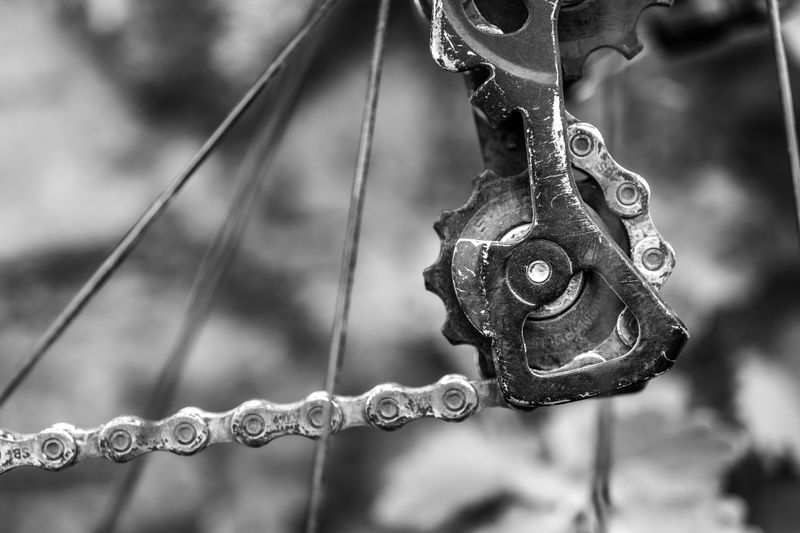
A chain has many small unsealed bearing surfaces and a large surface area. It rusts within days of exposure and the rust reaches the internal surfaces.
Surface rust on the outer plates is cosmetic. Rust between the pins and rollers increases friction and accelerates wear on the chain and everything it drives.
Lubricating a chain that has already corroded internally does not reverse it. This is why outdoor bikes wear drivetrains faster than their distance suggests.
Partial shelter captures most of the benefit
The full cost is paid by bikes fully exposed. A bike under a roof, out of direct sun and rain, ages far more slowly even with no walls around it.
Keeping it off the ground helps too, since the ground is a persistent moisture source and splashes reach the lower parts of the frame.
Where indoor storage is genuinely impossible, choosing components accordingly is the sensible response. Sealed bearings, stainless fasteners and a chain case address the specific mechanisms rather than the general problem.
Questions readers ask
My steering feels notchy in the straight-ahead position. What is that?
An indented headset bearing race, usually caused by riding with a loose headset. The notch cannot be polished out, so the bearing needs replacing, and the adjustment needs correcting afterwards.
How long should bearings last?
It depends far more on water and grit than on distance. A bike with mudguards and dry storage can go years; one ridden through salted winters without guards may need attention annually.