Maintenance
Why a New Cassette on an Old Chain Skips
Sprocket teeth wear into a shape matched to the worn chain running on them, so replacing one component without the other produces a mismatch that skips under load.
Fitting a new cassette and finding the drivetrain skips is a common and confusing outcome. The cause is that the two components had worn to fit each other.
Chain wear is elongation, not stretching of metal
A chain lengthens because the pins and the inside of the rollers wear against each other. The plates themselves do not stretch.
The result is that the spacing between rollers increases slightly. Over a chain's life that adds up to a measurable increase in overall length.
Sprocket teeth are cut for the original spacing. A longer chain no longer sits correctly in the valleys between them.
Sprockets wear to match the chain running on them
With a worn chain, load concentrates on fewer teeth and at a different point on each tooth face. Those faces wear into a profile matching the elongated chain.
The result is a set of sprockets that engage the worn chain smoothly. The pair works as a matched set, which is why nothing seemed wrong.
Fitting a new chain to those sprockets restores the original spacing against teeth cut for a different one. The chain rides up and skips under pedalling load.
The reverse mismatch is what causes the new-cassette case
Replacing the cassette while keeping the chain produces the same problem from the other direction. New teeth expect correct spacing and receive a lengthened chain.
Skipping appears immediately and is most obvious on the smaller sprockets, where fewer teeth are engaged and the load per tooth is highest.
It rarely improves with use. The new sprockets will eventually wear to match, and by then their useful life has largely been consumed.
Measuring chain wear removes the guesswork
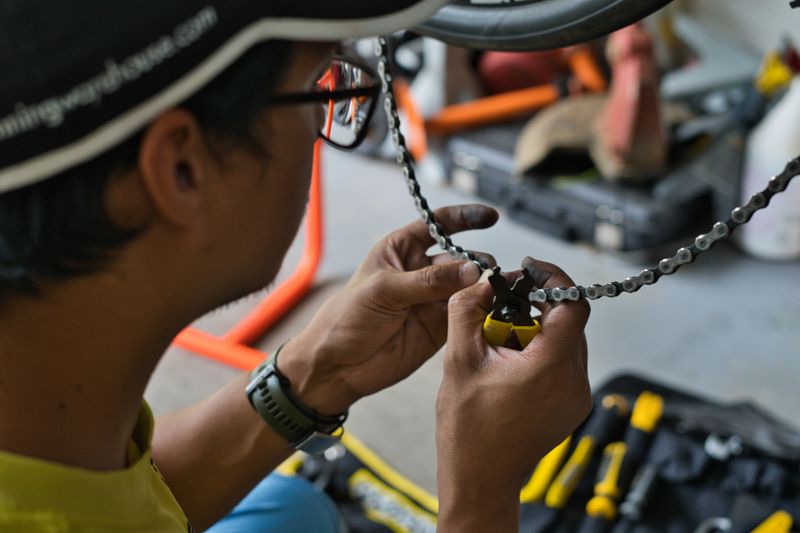
A chain wear indicator measures elongation across a set number of links. It is inexpensive and gives an unambiguous answer in seconds.
Replacing the chain before it passes the wear threshold means the sprockets never adapt to a worn profile. Several chains can then run on one cassette.
This is the cheapest maintenance strategy available on a bicycle, because chains cost far less than the components they wear.
Chainrings follow the same logic more slowly
Front chainrings wear the same way and take longer, because their teeth are more numerous and each carries proportionally less load.
A drivetrain neglected long enough will eventually need all three parts together. At that point replacing them as a set is the only arrangement that works.
Recognising which stage a drivetrain has reached avoids the frustrating middle case, where one new part is fitted and the bike rides worse than before.
Questions readers ask
My steering feels notchy in the straight-ahead position. What is that?
An indented headset bearing race, usually caused by riding with a loose headset. The notch cannot be polished out, so the bearing needs replacing, and the adjustment needs correcting afterwards.
How long should bearings last?
It depends far more on water and grit than on distance. A bike with mudguards and dry storage can go years; one ridden through salted winters without guards may need attention annually.