Riding the City
Hilly Cities Became Rideable When Motors Got Cheap
Gradient was the one barrier that better infrastructure could not remove. Electric assistance changed the calculation in places that had written cycling off.

Most explanations of hills and cycling uptake stop at the point where it starts to matter. This one carries on.
The short version
- Climbing cost depends on total weight and height gained.
- Assistance mainly removes the effort barrier, not the distance one.
- Hilly cities have seen faster proportional growth in e-bike use.
Why gradient was the hard barrier
Climbing requires lifting your combined weight, and that energy cost is fixed by physics rather than by road design. No amount of separation, signal priority or smooth surfacing reduces the effort of a sustained climb.
It also produces the arrival problem, since a hard climb in work clothes guarantees sweat. For riders carrying luggage, children or shopping, the cost multiplies with the load. That is why topography was consistently cited as the reason certain cities could never be cycling cities.
What assistance actually changes
A motor supplies part of the power needed to climb, which converts a hard effort into a moderate one. That mainly removes the effort barrier rather than the time barrier, since assisted speeds are limited in most jurisdictions. It flattens the perceived terrain, so route choice stops being dictated by contour lines.
The bit that actually matters: it also removes the arrival problem, which is what makes it practical for commuting in ordinary clothes. The effect on who can ride is larger than the effect on how fast anyone gets anywhere.
Who it brings in
Surveys of e-bike buyers repeatedly find substantial numbers of older riders, returning riders and people with health conditions. It also brings in people carrying loads, including cargo bike users replacing car trips for shopping and school runs. The demographic breadth is notably wider than that of conventional cycling in low-cycling countries.
With a loaded rack, that matters because a broader group of riders changes both political support and driver expectations. It is the clearest example available of technology widening participation rather than merely improving performance.
What it does not fix
Assistance does nothing about traffic danger, which remains the primary reason people give for not cycling. A hilly city with hostile roads simply becomes a hilly city where the hills are no longer the excuse. Cost is a real barrier, since electric bikes are considerably more expensive than conventional ones.
With a loaded rack, storage and charging requirements exclude some households, particularly in flats without secure ground-floor space.
Theft risk is higher because the machines are more valuable, which raises the parking stakes further.
What cities have to change
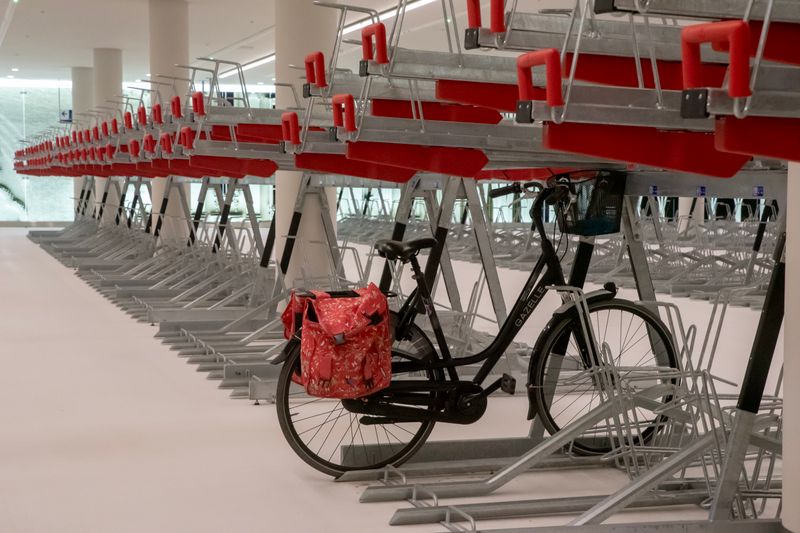
Heavier, faster machines need wider lanes, better sightlines and junction designs that account for higher approach speeds. Parking must accommodate longer and heavier bikes, including cargo bikes that do not fit conventional stands. Charging provision at workplaces and transport hubs extends useful range for longer commutes.
By the second week of riding, fire safety guidance for charging and storage in residential buildings has become a genuine policy question rather than a theoretical one. Cities that treat e-bikes as identical to bicycles in planning terms will find some of their provision inadequate.
Road law for cycles and e-scooters is local, and enforcement is more local still.
The equity question
Purchase subsidies and loan schemes exist in several countries, aimed at making assistance available beyond higher-income households. Shared e-bike fleets serve a similar function by removing the purchase cost entirely.
Without such measures the benefit accrues disproportionately to people who could already afford alternatives. Since the barrier being removed is physical effort, the people who would gain most are often those least able to pay. How that is addressed varies enormously, and it is one of the more consequential live debates in urban transport.
The takeaway
The motor removed the excuse about hills, and left every other question about the street exactly where it was.
Fix the small rattle. Every large repair began as one.
Questions readers ask
Do e-bikes actually get more people cycling?
Surveys consistently find e-bike buyers include many older, returning and load-carrying riders who were not cycling before. The effect is on who can ride rather than on how fast anyone travels.
Does assistance make hills irrelevant?
It removes most of the effort, which is the main barrier, but heavier machines still need good brakes for descents and cities still need to design for higher approach speeds.